Part of the New York Enrollment 2026ET series.
Correction (May 29, 2026): An earlier version overstated NYC traditional public school enrollment (1,042,265 in 2005 and 816,108 in 2026) and described the 2022 single-year NYC drop as the worst for any region in the dataset. The corrected traditional enrollment figures are 1,036,828 in 2005 and 811,535 in 2026, and the 2022 NYC decline is the second-largest regional drop, behind the rest of the state's 2021 COVID loss.
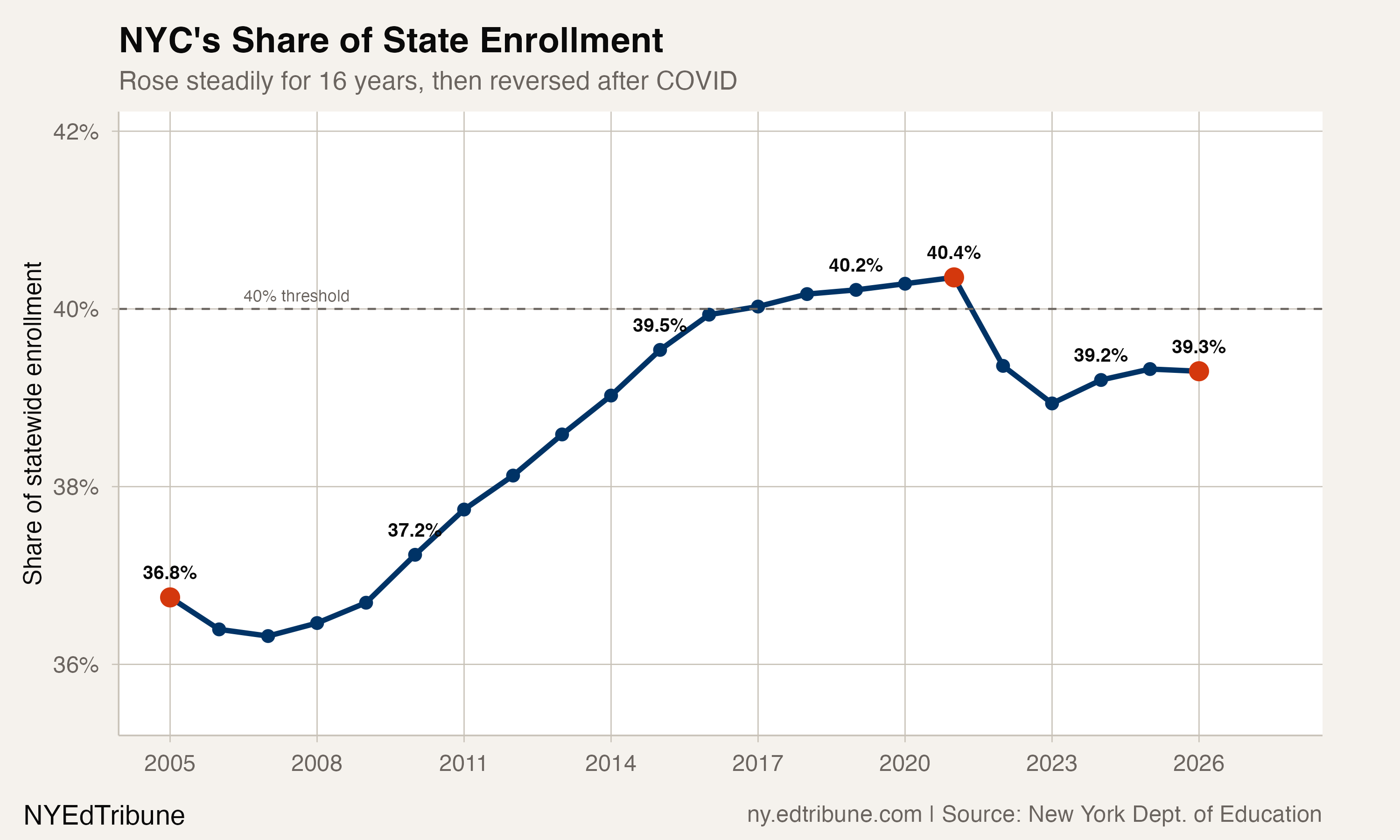
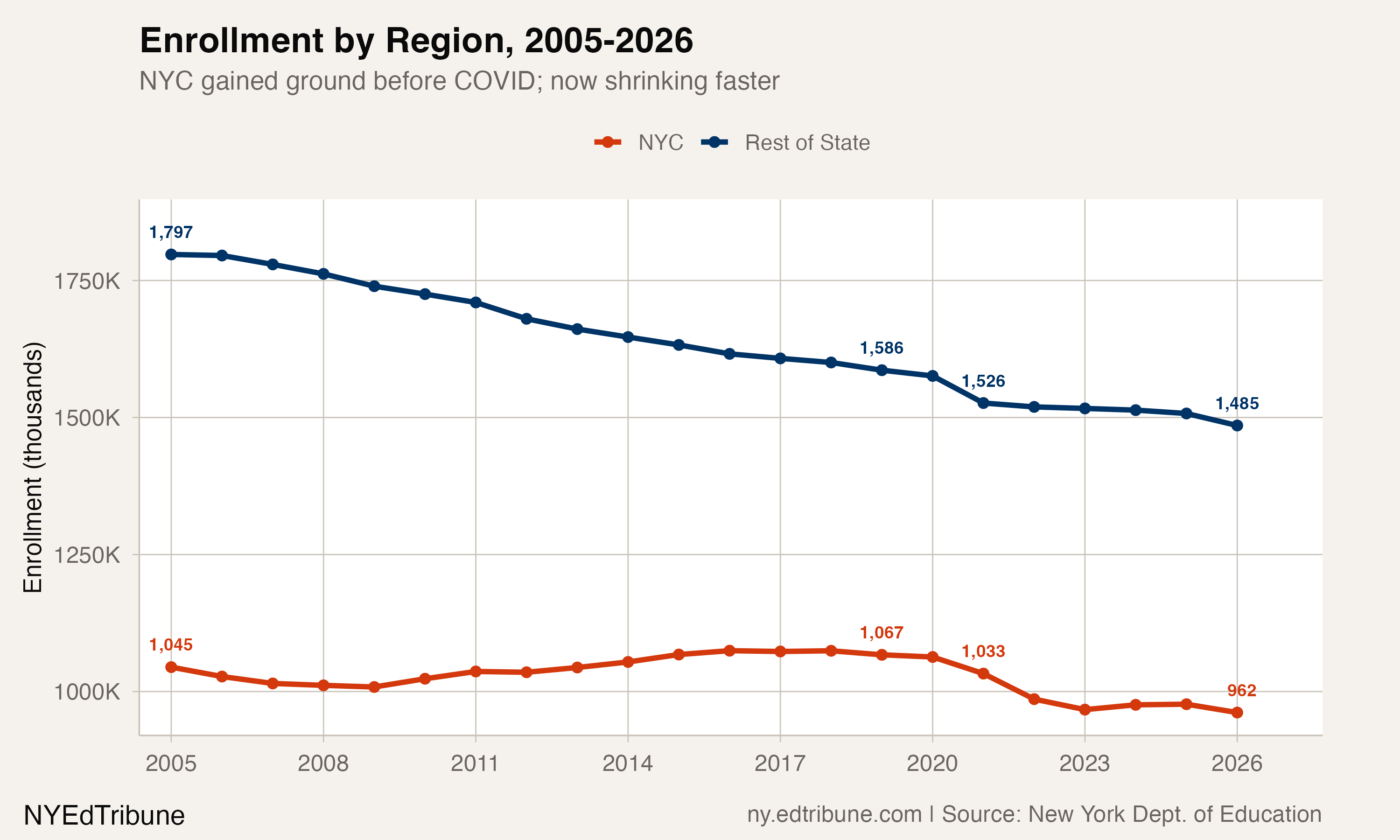
For 14 consecutive years, from 2008 through 2021, New York City claimed a larger and larger share of the state's public school enrollment. Not because the city was booming. Its enrollment was essentially flat for most of that stretch, peaking at 1,074,531 in 2016 before beginning a slow slide. NYC's share rose because everything outside the five boroughs was shrinking faster: the rest of the state lost 271,080 students between 2005 and 2021, a 15.1% decline, while NYC lost just 11,814, or 1.1%.
Then COVID broke the pattern. NYC's share peaked at 40.4% in 2021 and has fallen to 39.3% by 2026. In a state where nearly every metric trends downward, the reversal of NYC's gravitational pull is the structural story underneath the headline losses.
Why NYC gained ground without growing
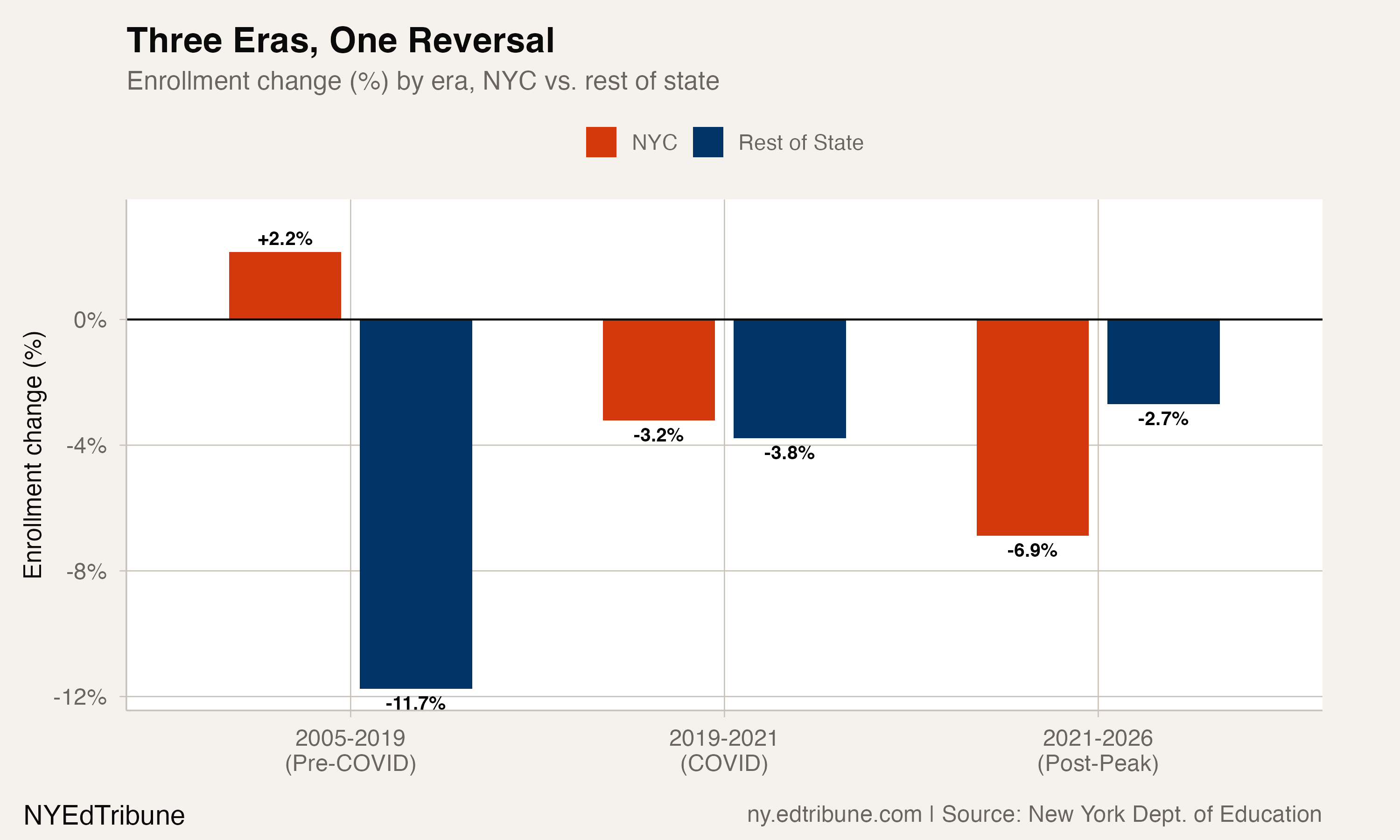
NYC's rising share before 2021 was never a growth story. It was a story about the speed of decline. Between 2005 and 2019, the rest of the state hemorrhaged 211,168 students, 11.7% of its enrollment, driven by demographic aging and out-migration across upstate and Long Island. NYC, by contrast, gained 22,468 students over the same period, a modest 2.2% increase buoyed by immigration and pre-K expansion. The city was treading water in a pool where everyone else was sinking.
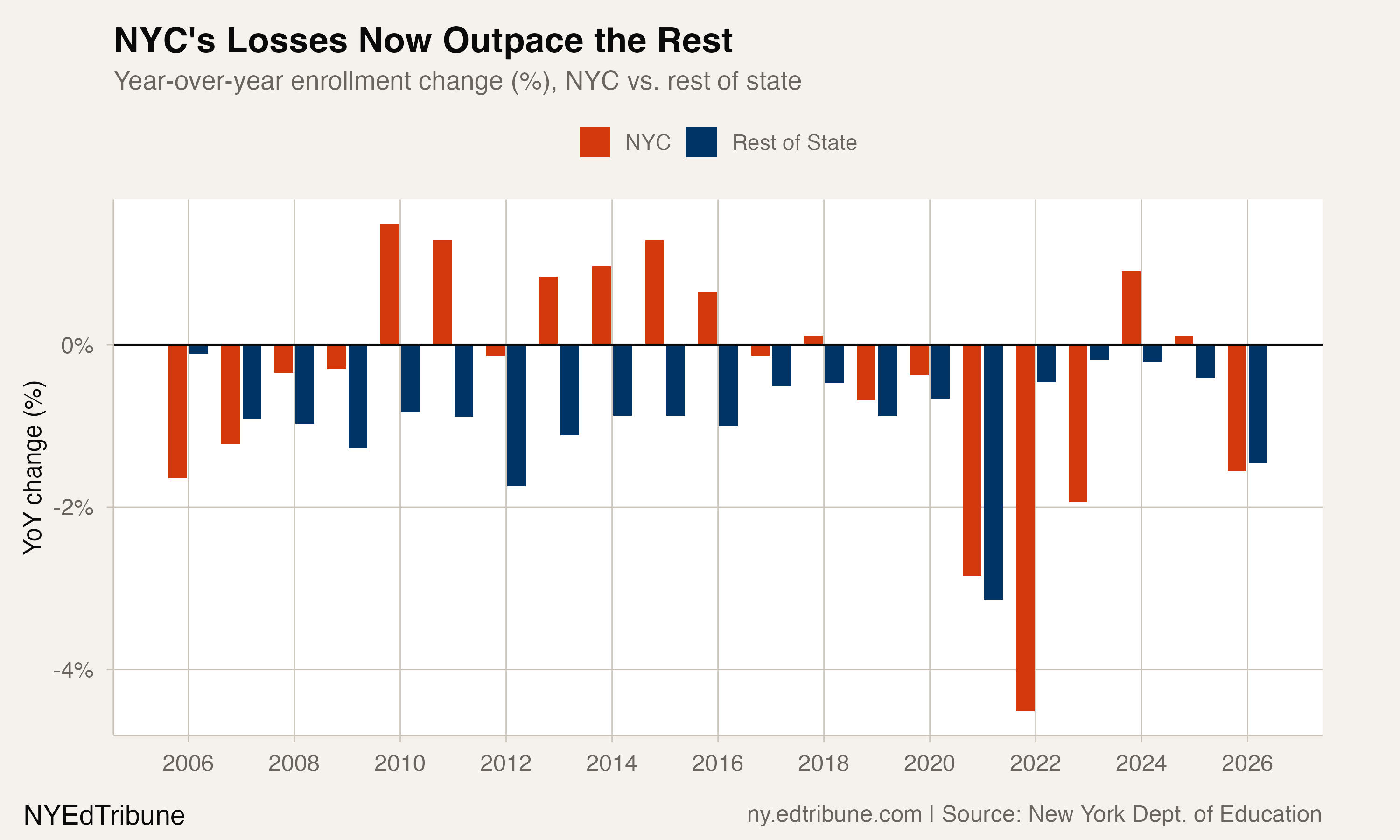
The pandemic scrambled this dynamic. In 2021, both regions lost students to COVID disruption: NYC dropped 30,313 (2.9%) and the rest lost 49,472 (3.1%). The rest of state's COVID loss was larger in both absolute and percentage terms, so NYC's share actually ticked up during the pandemic year itself. The reversal came in 2022, when the full weight of COVID's aftermath landed disproportionately on the city. NYC lost 46,599 students in a single year, 4.5%, while the rest of the state lost only 7,048, or 0.5%. That one year erased a full percentage point of NYC's share.
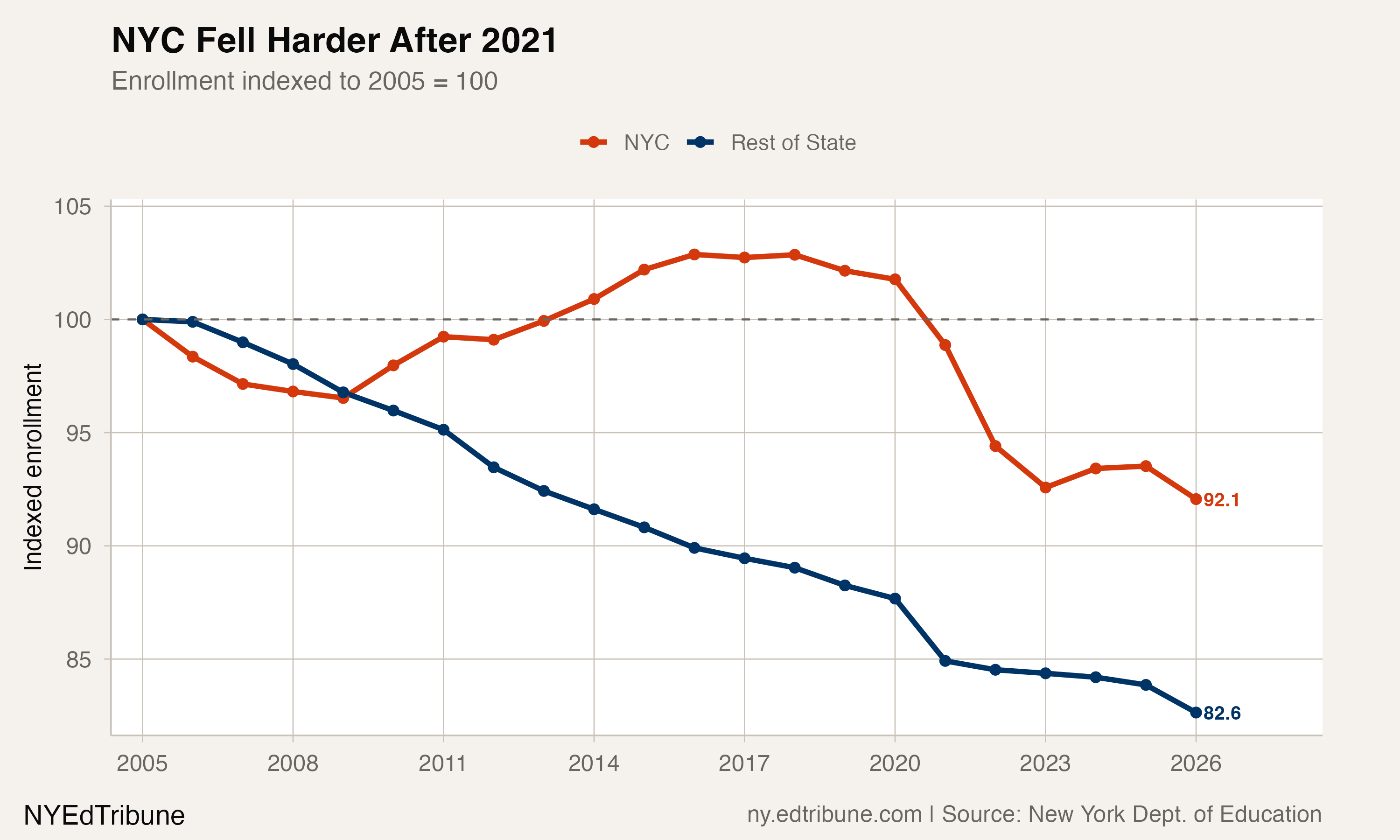
Since the 2021 peak, NYC has lost 71,081 students, 6.9% of its enrollment. The rest of the state has lost 41,009, or 2.7%. The roles have flipped: the city is now declining at more than double the rate of the suburbs and upstate.
What changed in 2022
The 2022 collapse in NYC enrollment, the worst single year for NYC in the dataset and the second-worst regional drop after the rest of state's 2021 COVID loss, had no single cause but several reinforcing ones.
The most immediate was pandemic flight. Families who could leave the city did, many permanently. Leslie Reynolds of Cornell's Program on Applied Demographics told Cornell Chronicle that "an aging population is the big driver of this pattern of K-12 enrollment decline, including people having fewer children and at later ages." But population aging affects the whole state. What hit NYC harder was three forces converging: pandemic flight enabled by remote work, faster private and parochial school recovery in the five boroughs, and a homeschooling surge that doubled the statewide rate to 1.8% with the heaviest concentration in the city.
The rest of the state, having already lost its most mobile families during the pre-pandemic decade, had fewer students left to lose. Upstate districts entered COVID already at or near their floors. NYC entered it near a plateau and had farther to fall.
The migrant bounce that did not last
The 2024 school year offered a brief counterpoint. NYC enrollment rose 8,775 students, its first gain in five years, driven by the arrival of asylum seekers. The Empire Center estimated that more than 36,000 students from migrant families entered NYC public schools between July 2022 and March 2024, following 225,700 asylum seekers who arrived in the city over roughly two years.
That inflow masked ongoing losses from families already in the system. And it has since reversed. Border encounters dropped 77% compared to 2023, the city shuttered dozens of migrant shelters starting in early 2025, and new student registrations fell. At 60 schools that had absorbed the most migrant students, enrollment dropped 11% in a single year.
"People are leaving, or they're staying in hiding." -- Power Malu, ROCCNYC co-founder, Chalkbeat NY, Nov. 2025
By 2025-26, NYC enrollment fell 15,223 students, dropping the city back to 961,666, its lowest level in the 22 years of data. The rest of the state lost 21,953 in the same year. For the first time since 2007, NYC and the rest of the state are declining at nearly identical rates, 1.6% and 1.5% respectively, and NYC's share has flatlined at 39.3%.
Two systems inside one city
Within NYC, the picture splits further. Traditional public school enrollment in the city has fallen from 1,036,828 in 2005 to 811,535 in 2026, a loss of about 225,000 students, or 21.7%. Charter schools, meanwhile, grew from 7,733 to 150,131 over the same period. The charter sector has absorbed a steadily rising share of a shrinking total.
The Empire Center reported that charter enrollment statewide climbed from 3.4% to 7% between 2013-14 and 2022-23, with the vast majority of that growth concentrated in the five boroughs. The practical effect: NYC's traditional district schools have lost more than one in five students, while the city's total enrollment, including charters, has lost fewer than one in ten. If the charter sector were removed from the count, NYC's share of the state total would look considerably worse.
What the funding formula does not adjust
New York's Foundation Aid formula includes a "save harmless" provision that prevents any district from receiving less state aid than it got the prior year, regardless of enrollment changes. The Empire Center noted that "school aid climbed 15 percent in inflation-adjusted dollars over the past decade" even as enrollment fell 10%.
For the rest of the state, save harmless has functioned as a floor that cushions the fiscal impact of losing students. For NYC, the sharper post-2021 decline exposes a harder problem: operating costs do not decline proportionally with enrollment. A school with 300 students and a school with 200 students need roughly the same principal, the same building, and many of the same support staff. As enrollment thins across hundreds of small schools, the per-pupil cost of maintaining a city-sized system on a shrinking enrollment base keeps rising, regardless of what Albany sends.
What comes next
NYC and the rest of the state declined at nearly identical rates in 2026 for the first time in a decade. Whether that convergence holds depends on two unknowns: the migrant pipeline, which drove the only recent NYC growth, and the speed at which upstate demographic decline continues its grind. If both continue, NYC's share could fall below 39% for the first time since 2013.
The 14-year run during which NYC became a steadily larger share of the state's student body is over. What replaced it is not a return to the pre-2008 pattern but something new: two regions declining in parallel, one having already lost its share premium, the other still reckoning with the structural consequences of serving 40% of a state's students on a shrinking base.
Detailed code that reproduces the analysis and figures in this article is available exclusively to EdTribune subscribers.
Discussion
Sign in to join the discussion.
Loading comments...