Part of the New York Enrollment 2026ET series.
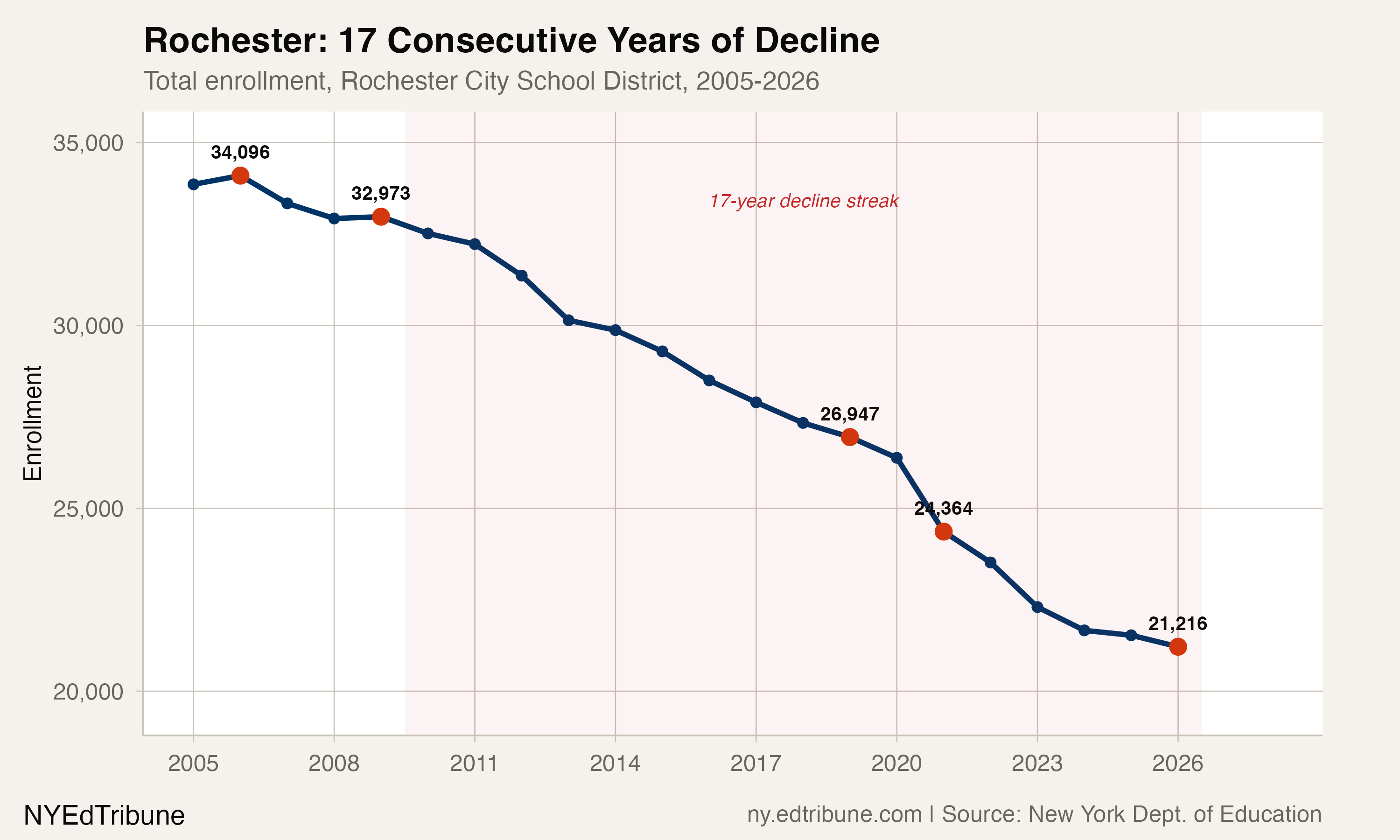
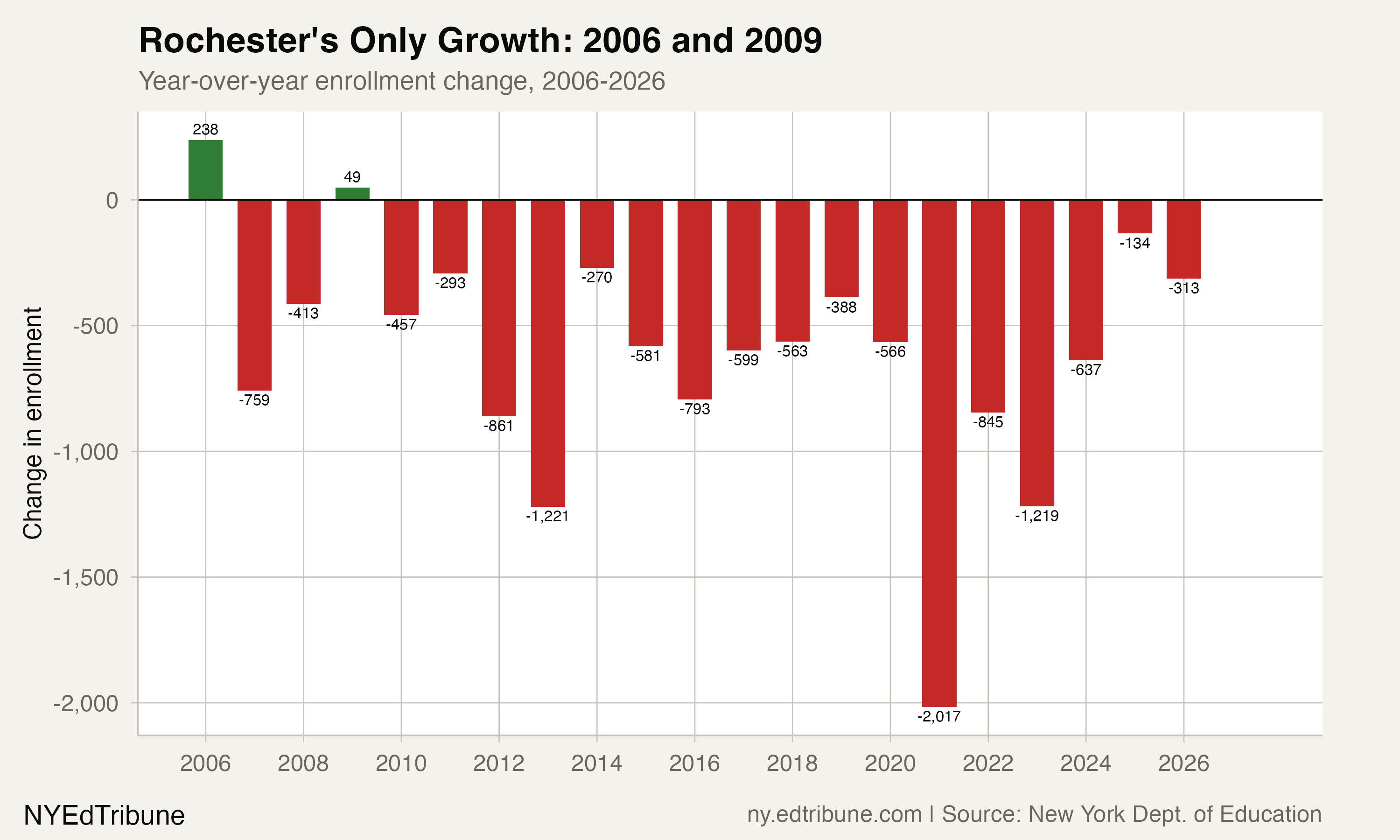
In 22 years of New York State enrollment data, Rochester↗ET has grown exactly twice: once in 2006, by 238 students, and once in 2009, by 49. Every other year the district shrank. Since that last blip of growth in 2009, Rochester has declined 17 consecutive years, losing 11,757 students, a 35.7% drop that leaves the district at 21,216 in 2025-26.
That 17-year streak stands alone among New York's Big Five upstate cities. Buffalo↗ET lost 9.2% over the same period from 2012 to 2026. Syracuse↗ET lost 8.2%. Yonkers↗ET lost 8.1%. Rochester's 32.4% decline over that same window is more than triple the rate of any peer.
A district built for 37,000 serving 21,000
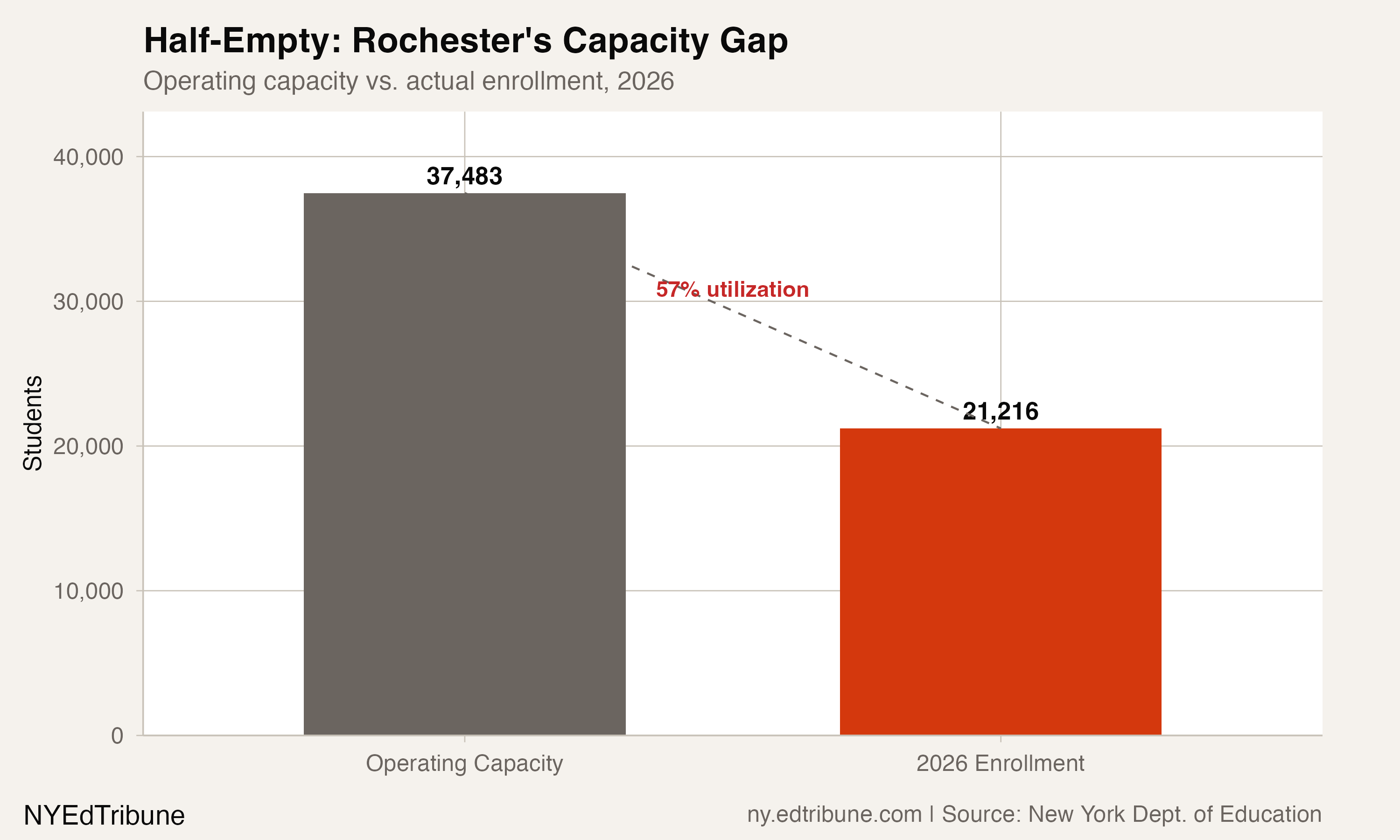
The scale of Rochester's contraction becomes concrete in its buildings. The district's operating capacity is 37,483 students, according to RCSD's own reconfiguration plan. It enrolled 21,216 in 2025-26. That is 57% utilization, meaning roughly two of every five seats sit empty.
Superintendent Carmine Peluso put the problem in starker terms when he announced the district's reconfiguration plan in 2023:
"Roughly 50% of our children that are born in the city are making their way into our schools," compared to 73% a decade earlier. — WXXI News, Sept. 2023
Half of Rochester's children never enter the district's doors. The board voted in October 2023 to close 11 schools across five buildings, simultaneously establishing new middle schools and consolidating programs. It was the largest reconfiguration in the district's modern history, and enrollment has continued to fall since.
COVID accelerated a trajectory that was already set
Rochester did not need the pandemic to decline. It was losing an average of 603 students per year from 2010 to 2019, a steady erosion driven by demographic contraction and competition from charters and suburban districts. COVID compressed years of loss into months: the district shed 2,017 students in 2020-21 alone, its worst single year.
The post-pandemic years have been worse than what came before. From 2022 to 2026, Rochester averaged 630 students lost per year, slightly above its pre-COVID pace, and the 2022-23 drop of 1,219 was nearly as large as the COVID year itself. The district has lost 3,148 students since its pandemic low, with no year of recovery.
Charters and the urban-suburban pipeline
Rochester-named charter schools enrolled 932 students in 2012. By 2026, that figure reached 4,353 across five entities, led by Rochester Prep CS 1 (1,482 students) and Rochester Academy CS (840). That 3,421-student increase in charter enrollment accounts for roughly a third of the district's 10,146-student loss over the same period. The relationship is not one-to-one; some charter students would not have attended RCSD regardless, and birth rate decline accounts for a share of the loss.
The Urban-Suburban Interdistrict Transfer Program, which allows Rochester students to attend schools in surrounding suburban districts, provides another exit. The program was designed to reduce racial isolation and deconcentrate poverty, but it also removes students from RCSD's enrollment count and the per-pupil funding that follows them.
Rochester's population itself is contributing to the pipeline. Monroe County lost 1.4% of its residents between April 2020 and July 2023, according to Census estimates, with the city of Rochester declining 1.9% to 207,274 by 2023. A 2024 rebound driven by international migration brought Monroe County's population back to 752,202, but that growth has not yet translated into school enrollment.
The pipeline is inverting
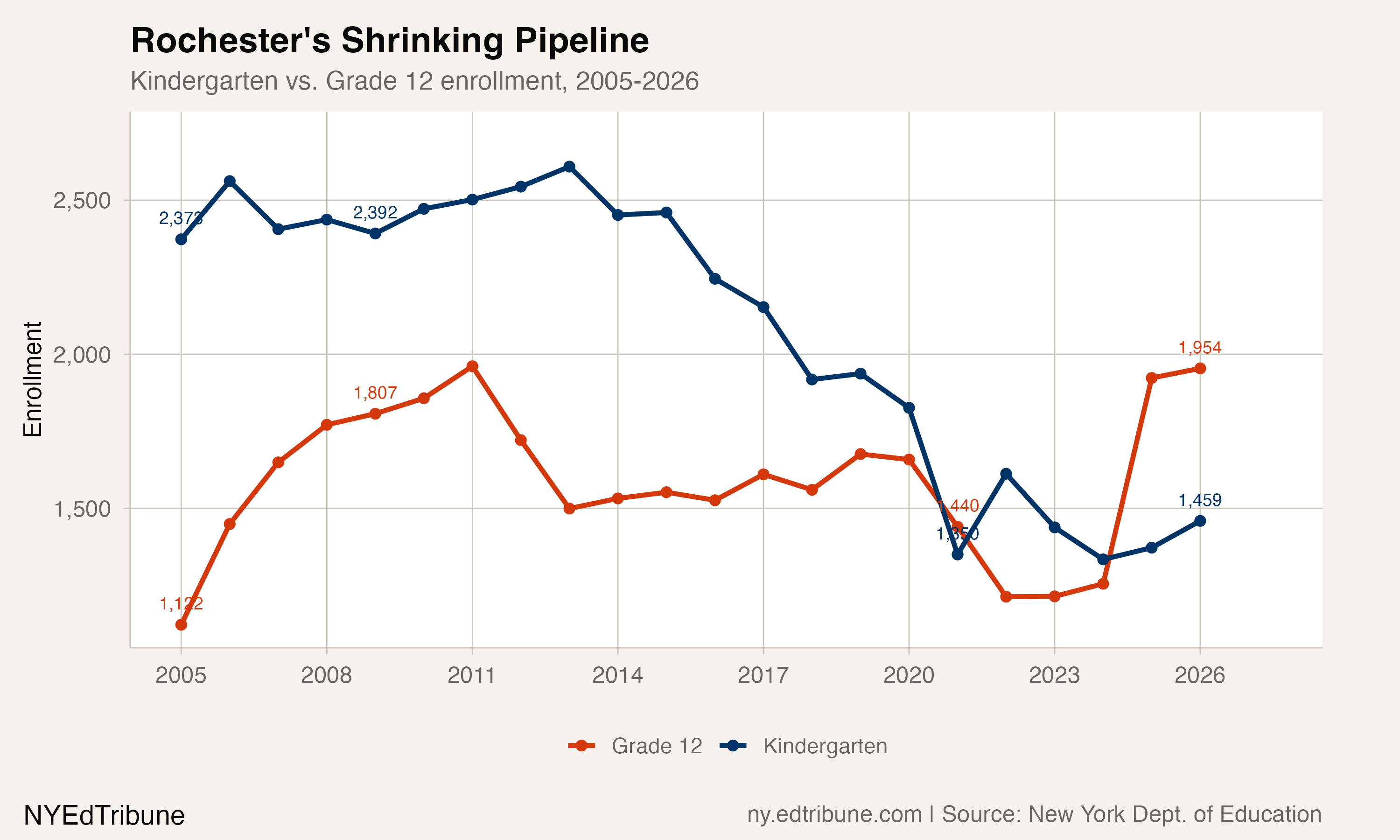
Rochester enrolled 2,392 kindergartners in 2009. By 2026, that number had fallen to 1,459, a 39.0% decline. At the other end, Grade 12 enrollment has risen from 1,807 in 2009 to 1,954 in 2026, an 8.1% increase. The K-to-G12 pipeline has inverted: Rochester now graduates more seniors than it enrolls kindergartners.
Kindergarten hit 1,350 during COVID in 2021, briefly recovered, then fell to a new low of 1,334 in 2024. The 2026 figure of 1,459 represents a modest rebound from that floor but remains 39% below the 2009 level. The pattern reflects both Rochester's falling birth rate and the decisions families continue to make about whether to enter the public system at all.
No peer trajectory compares
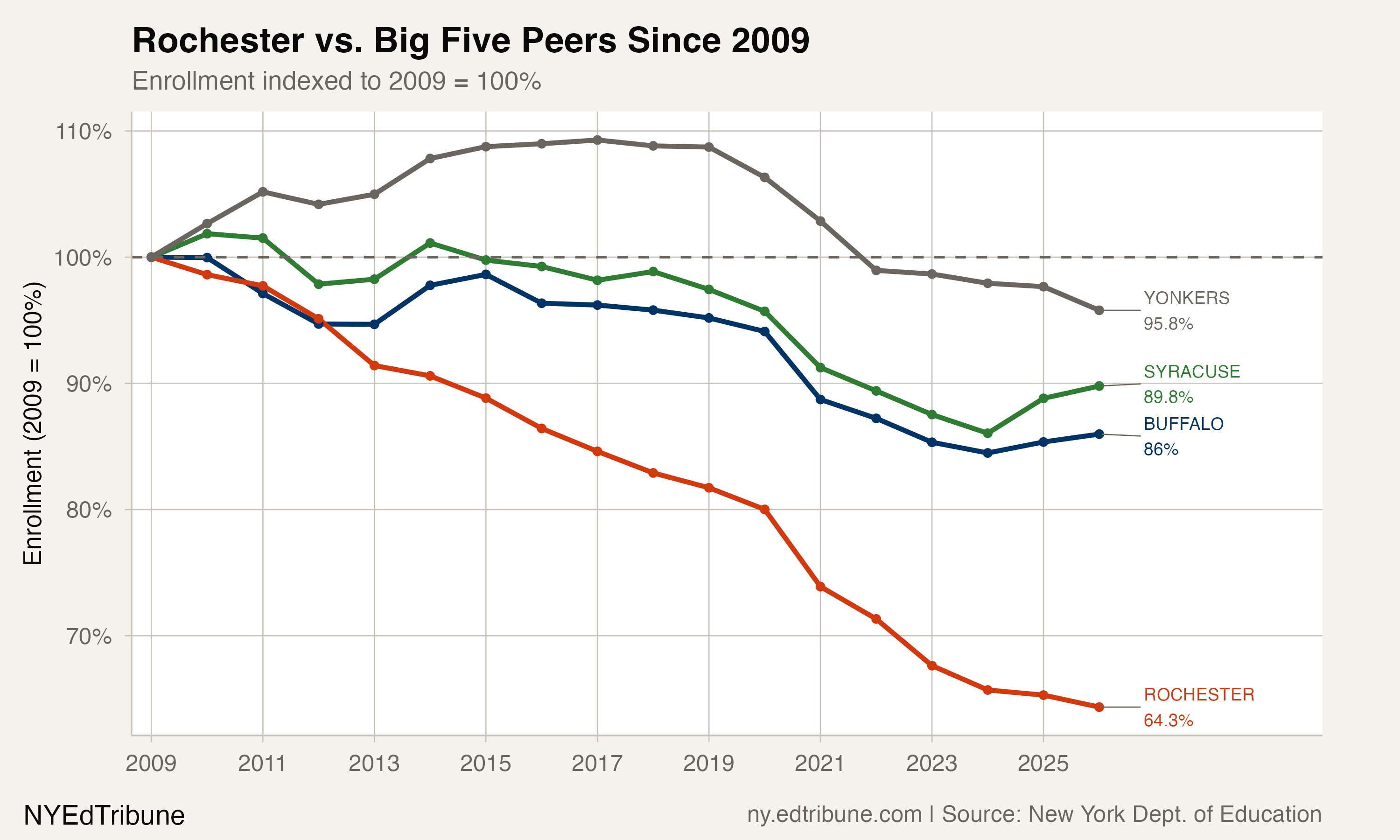
Among the Big Five (excluding NYC, which is structured as 32 geographic districts), Rochester's indexed decline since 2009 is in a category of its own. Buffalo, which was actually larger than Rochester in 2012 at 32,709 students, has declined at roughly one-quarter the rate. Syracuse has held relatively flat. Yonkers, which has its own nine-year decline streak, has lost only 4.2% since 2009.
Rochester's trajectory is not merely the worst of the Big Five. It is structurally different: the other four districts experienced COVID as a disruption within a manageable trend. Rochester experienced COVID as an acceleration of a trend that was already unsustainable.
A billion-dollar budget for a shrinking district
Rochester approved a $1.1 billion budget for 2025-26 after closing a $38 million gap through state aid increases and the elimination of more than 130 positions. The district's per-pupil spending exceeds $30,000, among the highest in the state. Its ELA proficiency rate is 16% and its math proficiency rate is 12%, according to the Empire Center's K-12 SOS analysis, compared to state averages of 48% and 52%.
The fiscal pressure is compounding. For 2026-27, the district faces a $53.1 million budget gap, with transportation costs projected to rise 17% to $90 million and health insurance costs increasing 15% to 18%. CFO Robert McDow acknowledged the enrollment challenge directly:
"We have a lot of students leaving. We need to bring them back." — Rochester Beacon, Jan. 2026
Board Vice President Amy Malloy warned that the district's reserves will not last: "Right now, we have a very comfy fund balance and cushion, but that's going to deplete very quickly within four or five years."
Looking further ahead, RCSD's own projections show enrollment dropping to approximately 15,600 by 2031, which would push cumulative deficits past $68 million without intervention. New York's Foundation Aid "save harmless" provision prevents outright funding cuts, but it cannot compensate for a district whose student body has shrunk by more than a third in two decades while its cost structure has not.
Detailed code that reproduces the analysis and figures in this article is available exclusively to EdTribune subscribers.
Discussion
Sign in to join the discussion.
Loading comments...