Part of the New York Enrollment 2026ET series.
For every kindergartner who disappeared from New York's public schools over the past 14 years, the state added a fraction of a Pre-K student to replace them. That fraction never came close to one-for-one.
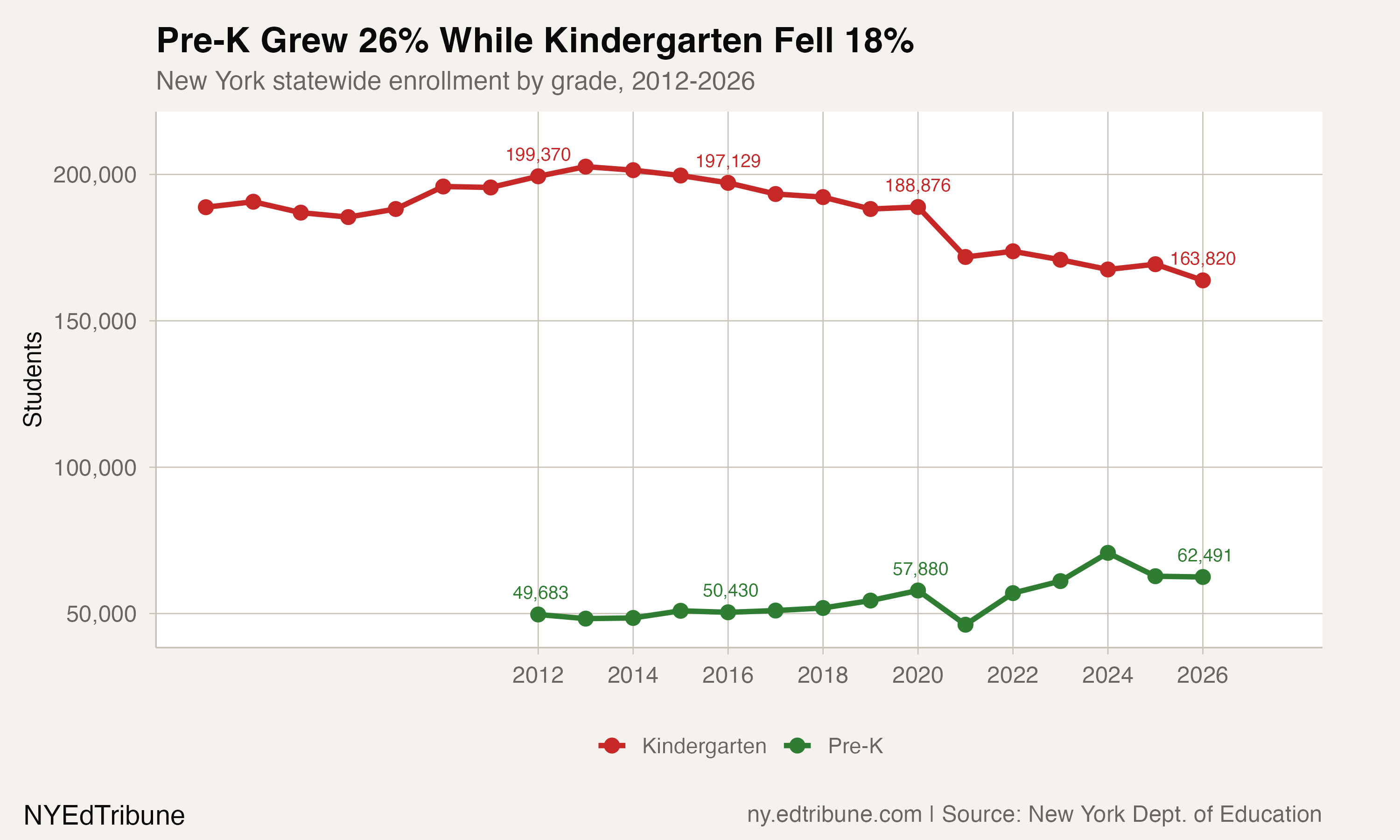
Since 2012, the first year Pre-K data appears in state records, New York's Pre-K enrollment grew from 49,683 to 62,491, a gain of 12,808 students, or 25.8%. Over the same period, kindergarten enrollment fell from 199,370 to 163,820, a loss of 35,550 students, or 17.8%. Kindergarten hit its lowest level in the 22-year state dataset. Pre-K is growing, K is shrinking, and the pipeline connecting them is broken.
The ratio that reveals the disconnect
The simplest way to see the divergence: for every 100 kindergartners in New York's public schools, how many Pre-K students are enrolled? In 2012, the answer was 25. By 2026, it reached 38.
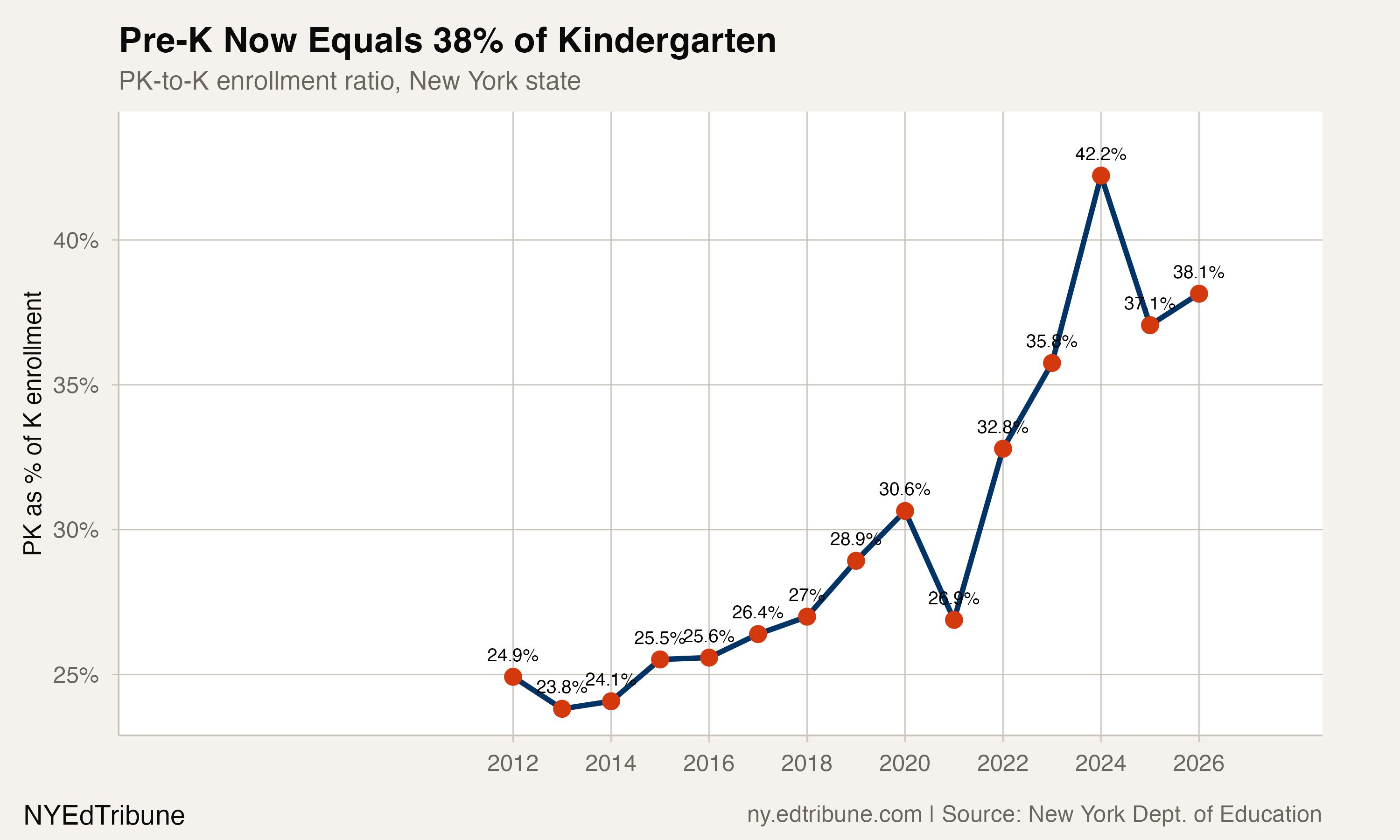
That ratio peaked at 42.2% in 2024, when Pre-K enrollment spiked to 70,741, an all-time high driven partly by NYC programs enrolling children from newly arrived immigrant families. The spike reversed in 2025, when Pre-K dropped by nearly 8,000 students to 62,759. But even after that correction, Pre-K enrollment in 2026 remains 25.8% above where it started.
Kindergarten, by contrast, peaked at 202,679 in 2013 and has fallen in 11 of the 13 years since. The COVID year of 2021 punched a 17,062-student hole in the kindergarten class, a 9.0% single-year decline. That cohort never came back. Kindergarten in 2026 sits 7,994 students below even the COVID trough.
NYC built the program. The rest of the state caught up.
New York City accounts for nearly half of all statewide Pre-K enrollment, 30,268 of 62,491 students in 2026, or 48.4%. That share has grown from 45.1% in 2012, but the more notable pattern is how differently the two regions arrived at their current numbers.
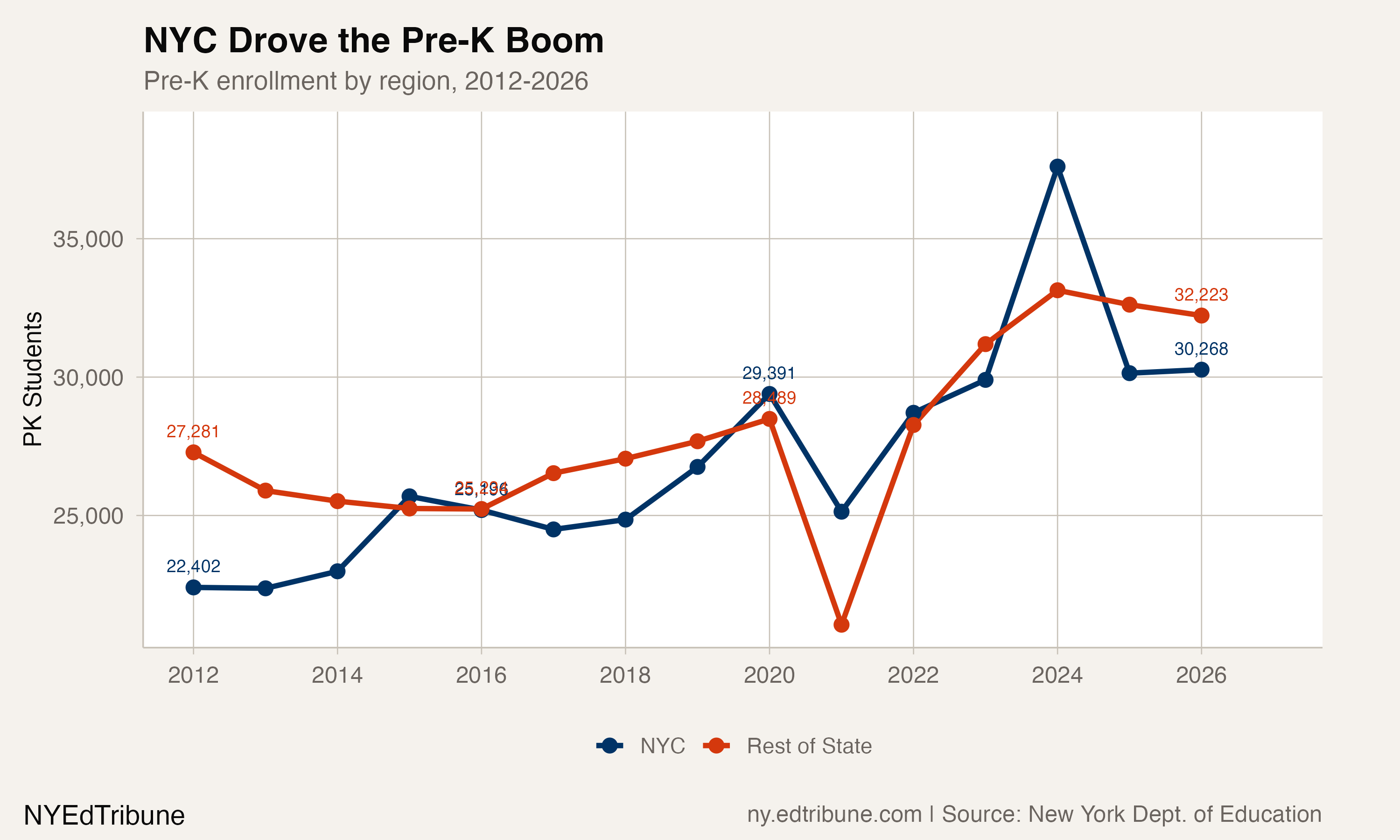
NYC's Pre-K enrollment grew 35.1% since 2012, from 22,402 to 30,268. The rest of the state grew 18.1%, from 27,281 to 32,223. But NYC's path was volatile. The city's Pre-K count spiked to 37,604 in 2024, then crashed by 7,462 students over the following year, likely reflecting the enrollment and subsequent departure of migrant families from city programs. Outside NYC, growth was steadier: Pre-K enrollment outside the city now exceeds city enrollment by nearly 2,000 students, a reversal from 2012 when it led by 4,879.
The explanation for NYC's trajectory is straightforward. Mayor Bill de Blasio launched Pre-K for All in 2014 with an additional $300 million in state funding, tripling city Pre-K enrollment from roughly 19,000 to 68,000 within a year. The program guaranteed a free seat to every four-year-old in the city, regardless of income or immigration status.
Outside NYC, the expansion has been slower and less complete. As of 2023, only 59% of eligible four-year-olds outside the city were enrolled in publicly funded Pre-K, and just 4% of three-year-olds statewide had access. Per-pupil grants have been frozen without inflation adjustments, with the lowest-wealth districts receiving $9,100 per student and the wealthiest receiving $5,000.
Why more Pre-K has not meant more kindergartners
The central puzzle: if Pre-K is capturing 12,800 more students than it did in 2012, why has kindergarten enrollment fallen by 35,550?
The most likely answer is that Pre-K expansion did not bring new students into the public system. It brought them in earlier. Children who would have entered public school at kindergarten are now entering at Pre-K, shifting the enrollment curve one year earlier without increasing the total number of students flowing through. The Pre-K program is a pipeline accelerator, not a pipeline expander.
The birth rate data supports this interpretation. New York's fertility rate fell 12% between 2008 and 2020, from 61.2 to 54.1 births per 1,000 women of childbearing age. The steepest declines hit younger mothers: a 56% drop among 18-19 year-olds and a 33% drop among 20-24 year-olds. Fewer babies born in 2017-2020 means fewer kindergartners in 2022-2026, and no amount of Pre-K expansion can manufacture children who do not exist.
"Per pupil costs tend to increase when enrollment falls as the same costs are spread across a smaller student population." -- New York State School Boards Association, Jan 2024
Whether some families use the free Pre-K year then opt out at kindergarten for private school or homeschooling is unknowable from state data, but the scale of the kindergarten decline far exceeds plausible leakage.
The downstream pipeline is contracting
Pre-K is the only grade level in New York that has grown since 2012. Every other measured grade has declined.
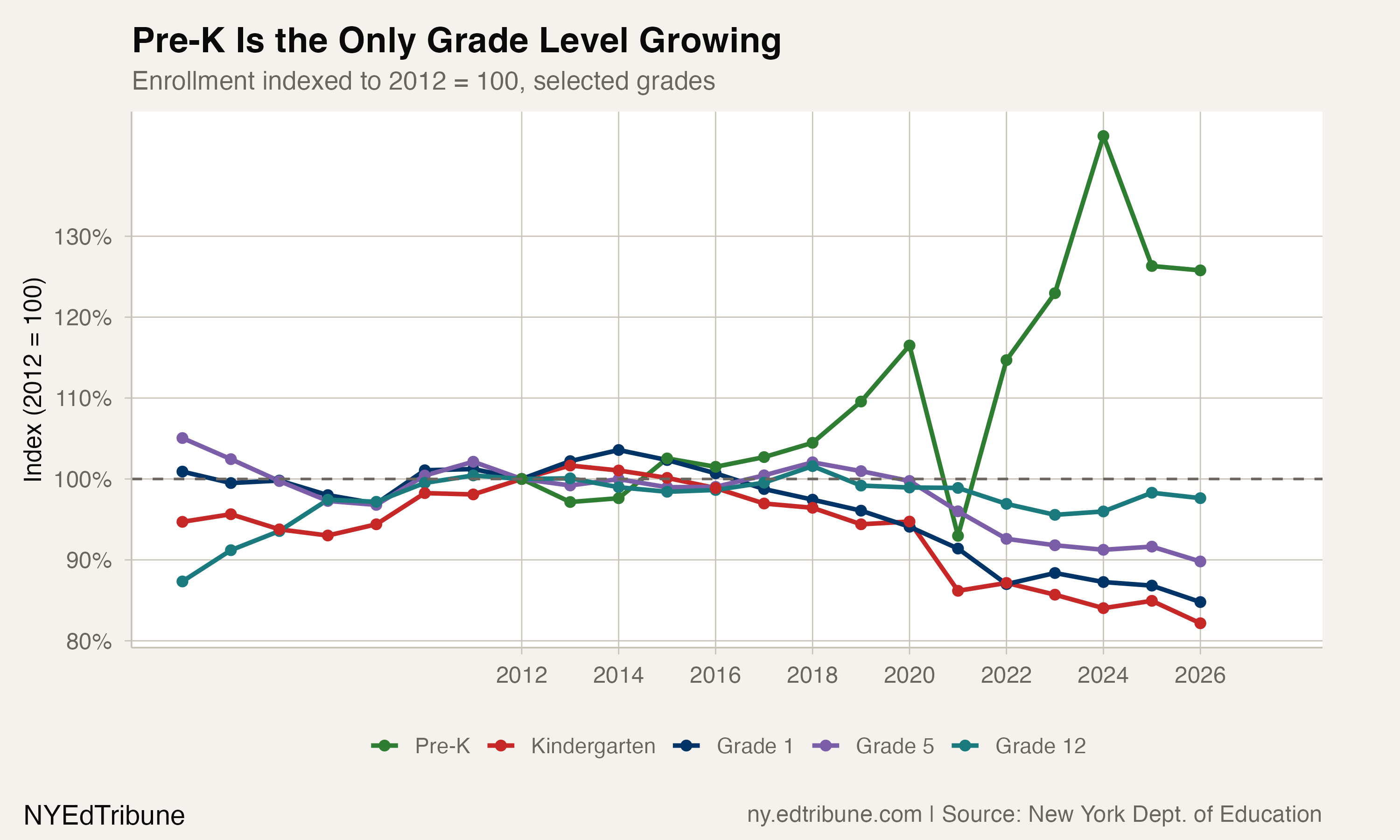
Elementary enrollment (K through grade 5) has lost 154,006 students since 2012, a 12.9% decline. Grade 12, meanwhile, has barely moved: 191,515 then, 186,975 now, a loss of just 2.4%. The kindergarten contraction has not yet reached the upper grades. It will. The 163,820 students who entered kindergarten in 2026 will become the grade 12 class of 2038.
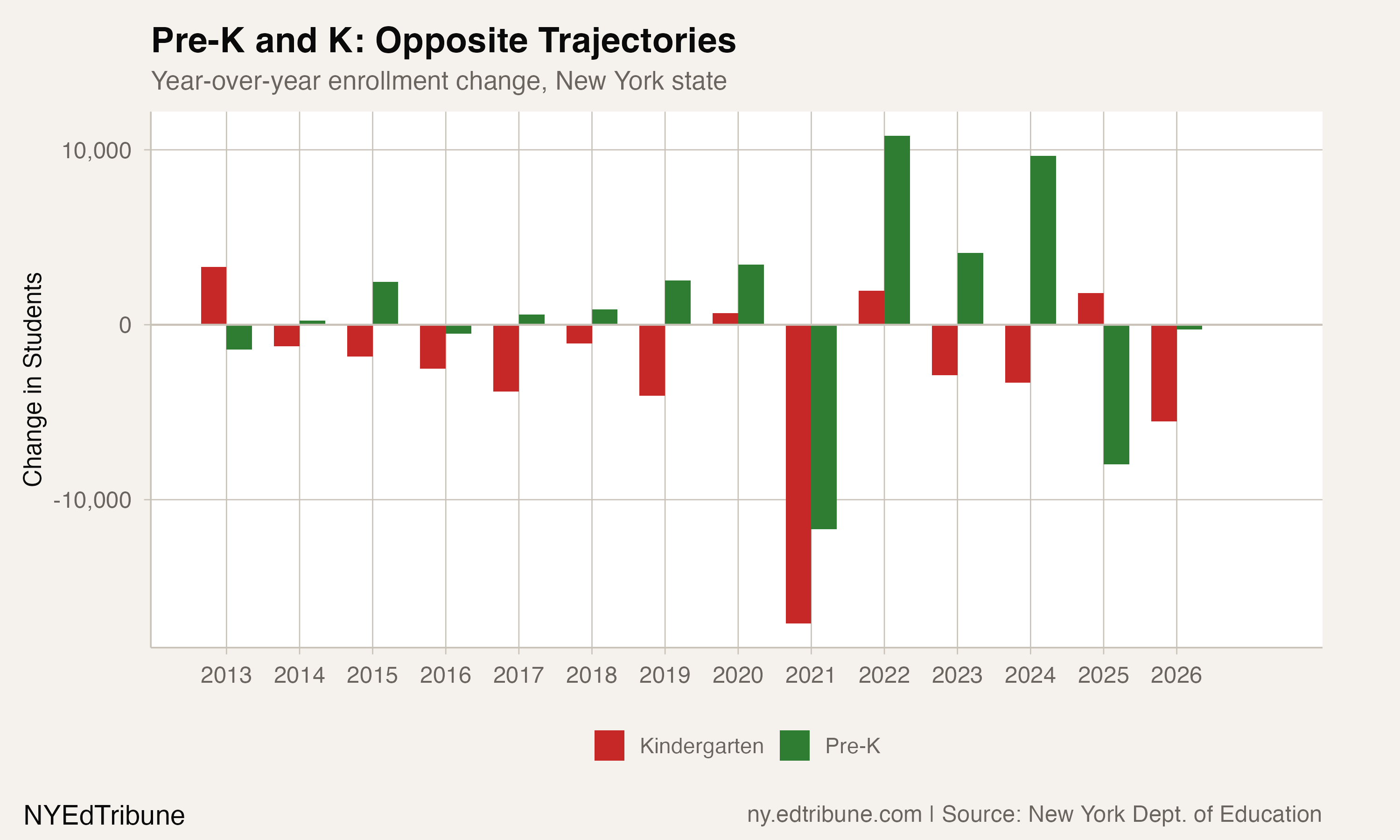
The year-over-year pattern shows the two grades moving in opposite directions with remarkable consistency. In 2024, Pre-K gained 9,650 students while kindergarten lost 3,319. In 2021, both took a COVID hit, but Pre-K's was proportionally worse: a 20.2% decline versus kindergarten's 9.0%. Pre-K recovered fully by 2022. Kindergarten never did.
Where the Pre-K students are
The districts adding the most Pre-K students since 2012 are overwhelmingly NYC geographic districts. Queens District 27 added 854 Pre-K students. Rochester↗ET added 831, growing its Pre-K program 87.5% from 950 to 1,781. Bronx District 9 added 783, a 161% increase. Queens District 24 added 749, a 229% increase from a base of just 327.
Buffalo↗ET runs one of the larger upstate Pre-K programs at 1,662 students in 2026. Outside the Big Five cities, Pre-K programs are smaller but growing. The statewide expansion of state-funded Universal Pre-K, which New York established in 1997 as the second state to create such a program, has pushed enrollment upward even in districts where kindergarten is declining.
The question Pre-K cannot answer
New York invested $1.2 billion in Pre-K programs for the 2024-25 school year. The state's overall enrollment has fallen to its lowest point since the early 1950s. Pre-K expansion has not reversed that trajectory, and it was never designed to. The program's purpose is school readiness, not enrollment recovery.
New York invested $1.2 billion in Pre-K in 2024-25. It has not reversed the enrollment decline, and it was never designed to. What Pre-K did was shift the entry point: children who would have started at kindergarten now start a year earlier. The program is an on-ramp, not a population multiplier. And the on-ramp leads into a system that enrolled its smallest kindergarten class in 22 years. The 163,820 five-year-olds who walked into classrooms in fall 2025 are already outnumbered by the seniors walking out.
Detailed code that reproduces the analysis and figures in this article is available exclusively to EdTribune subscribers.
Discussion
Sign in to join the discussion.
Loading comments...