Part of the New York Enrollment 2026ET series.
District 8↗ET has lost students every year since 2013. Not most years. Every year. Fourteen consecutive annual declines, without a single year of growth. District 10↗ET and District 9↗ET are on 10-year losing streaks of their own. Together, these three Bronx geographic districts enrolled 126,590 students in 2012. By 2026, that number had fallen to 87,562, a loss of 39,028 students, or 30.8% of their combined enrollment.
That is structural contraction. In Morrisania, Fordham, Norwood, and Throgs Neck, schools cannot operate the same way they did a decade ago. All three districts hit all-time lows in 2025-26.
The scale of it
District 10, the largest of the three, stretches from Fordham through Norwood and into parts of Riverdale. It fell from 58,576 students in 2012 to 41,251 in 2026, a loss of 17,325 students (29.6%). District 9, covering Morrisania and Tremont in the South Bronx, fell from 36,321 to 24,040, losing 12,281 students (33.8%). District 8, which includes Throgs Neck and parts of Pelham Bay, fell from 31,693 to 22,271, a loss of 9,422 (29.7%).
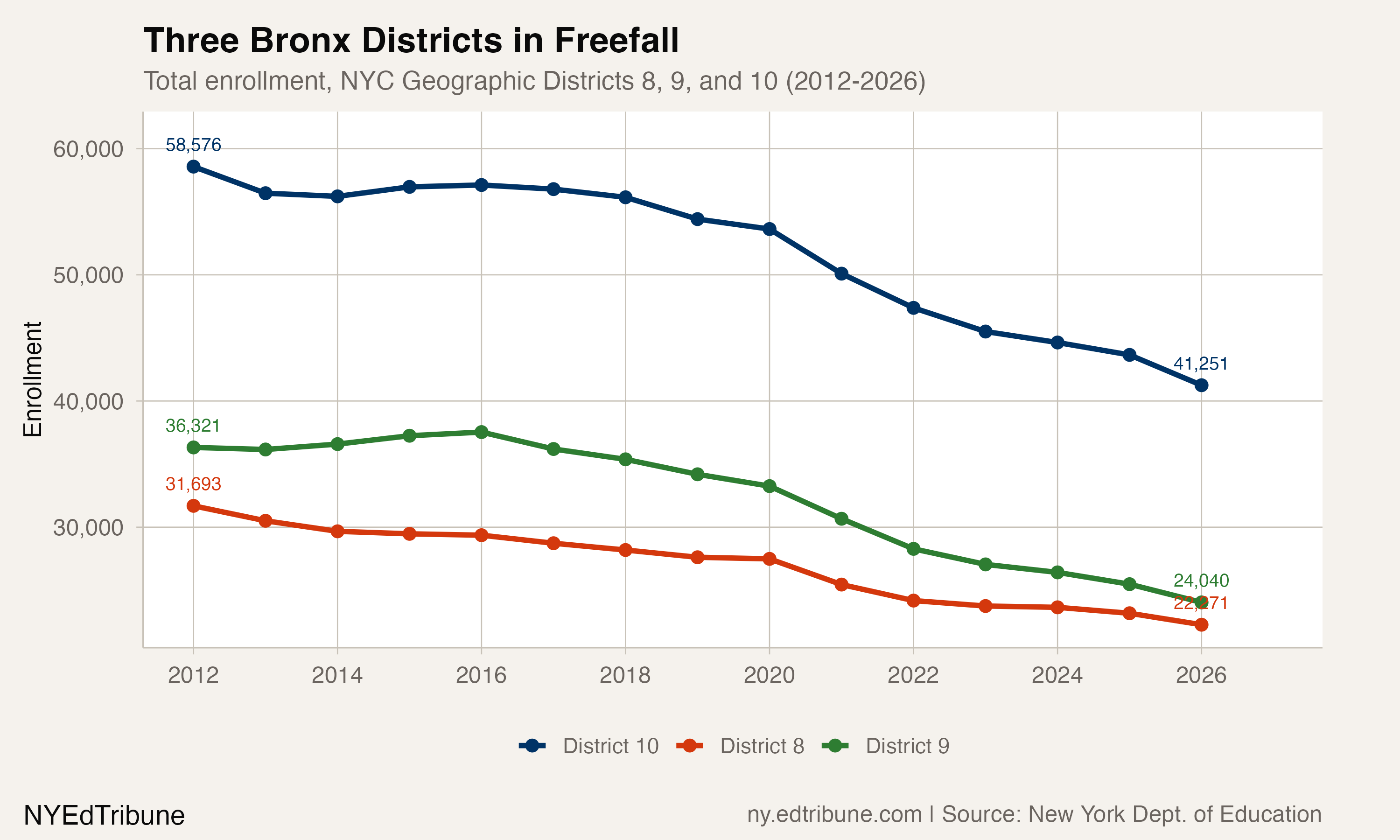
District 9's trajectory is the steepest on a percentage basis. It actually grew through 2016, peaking at 37,536. Its decline from peak to present is 35.9%. District 10, by contrast, never had a recovery year after 2016. District 8 has been shrinking since 2013 without interruption.
These three districts account for 65.4% of the total enrollment loss across all six Bronx geographic districts. The borough as a whole fell from 208,789 to 149,117 students over the same period, a 28.6% decline.
Acceleration, not stabilization
The loss is getting worse, not better. Between 2012 and 2017, the three districts combined lost an average of about 975 students per year. Between 2017 and 2020, that accelerated to roughly 2,448 per year. Since 2020, the average annual loss has been 4,468.
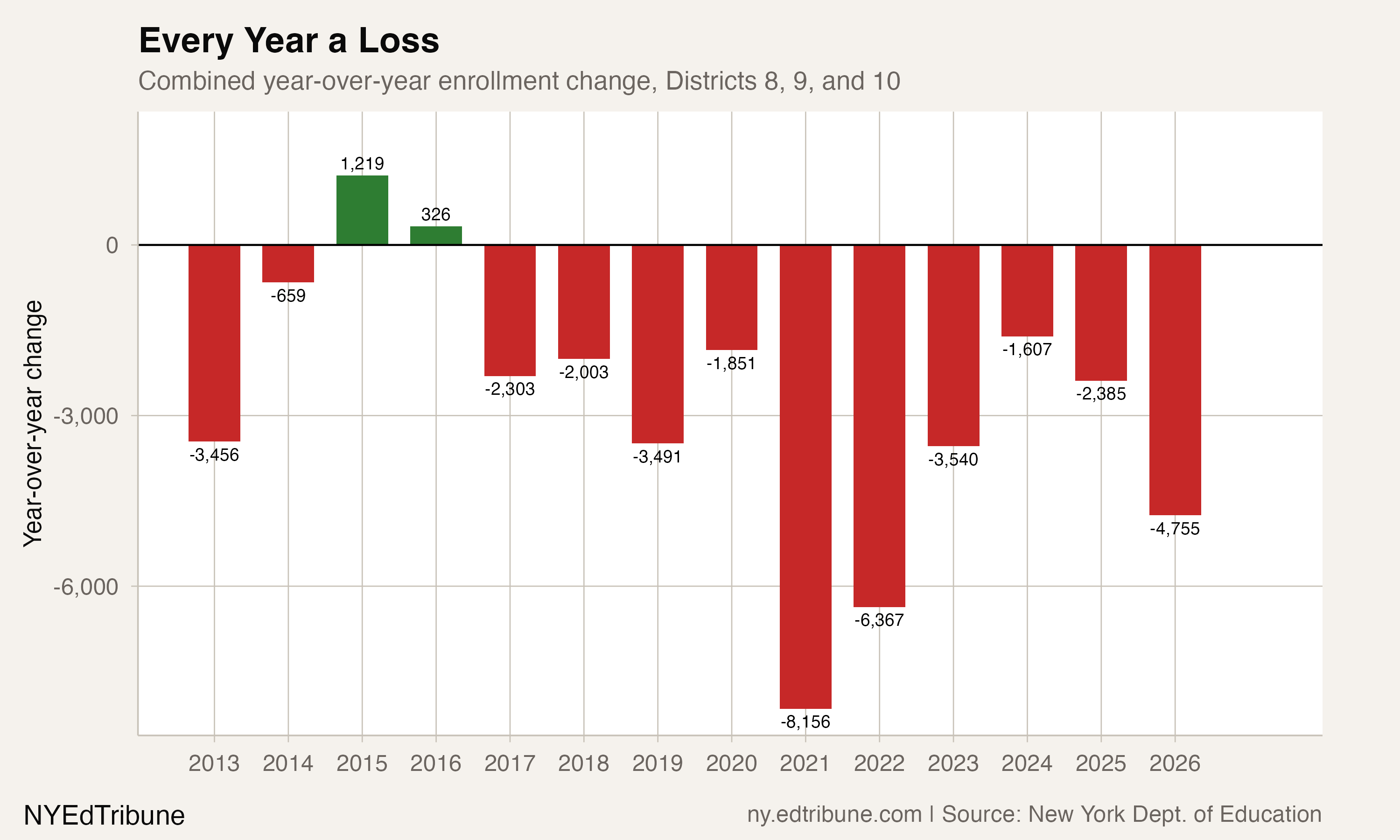
The pandemic years of 2021 and 2022 were catastrophic: combined losses of 8,156 and 6,367 respectively. But the 2026 loss of 4,755 is the largest in any non-pandemic year, suggesting the underlying decline is still accelerating even after the acute COVID shock faded. Only two of the 14 years since 2012 saw any combined gain (2015 and 2016, both modest), and neither interrupted the district-level streaks for Districts 8 or 10.
The post-COVID era has been worse than the pre-COVID era for all three. District 10 lost 4,947 students across the entire eight years from 2012 to 2020. It then lost 12,378 in just the six years since, two and a half times as many in three-quarters of the time. District 9 lost 3,067 pre-COVID and 9,214 after. District 8 lost 4,204 and then 5,218.
The kindergarten signal
Kindergarten enrollment is where the future announces itself. Across the three districts, K enrollment fell from 9,727 in 2012 to 5,293 in 2026, a 45.6% decline. That is nearly double the rate of total enrollment loss, and it means the pipeline feeding these districts' elementary schools has been cut nearly in half.
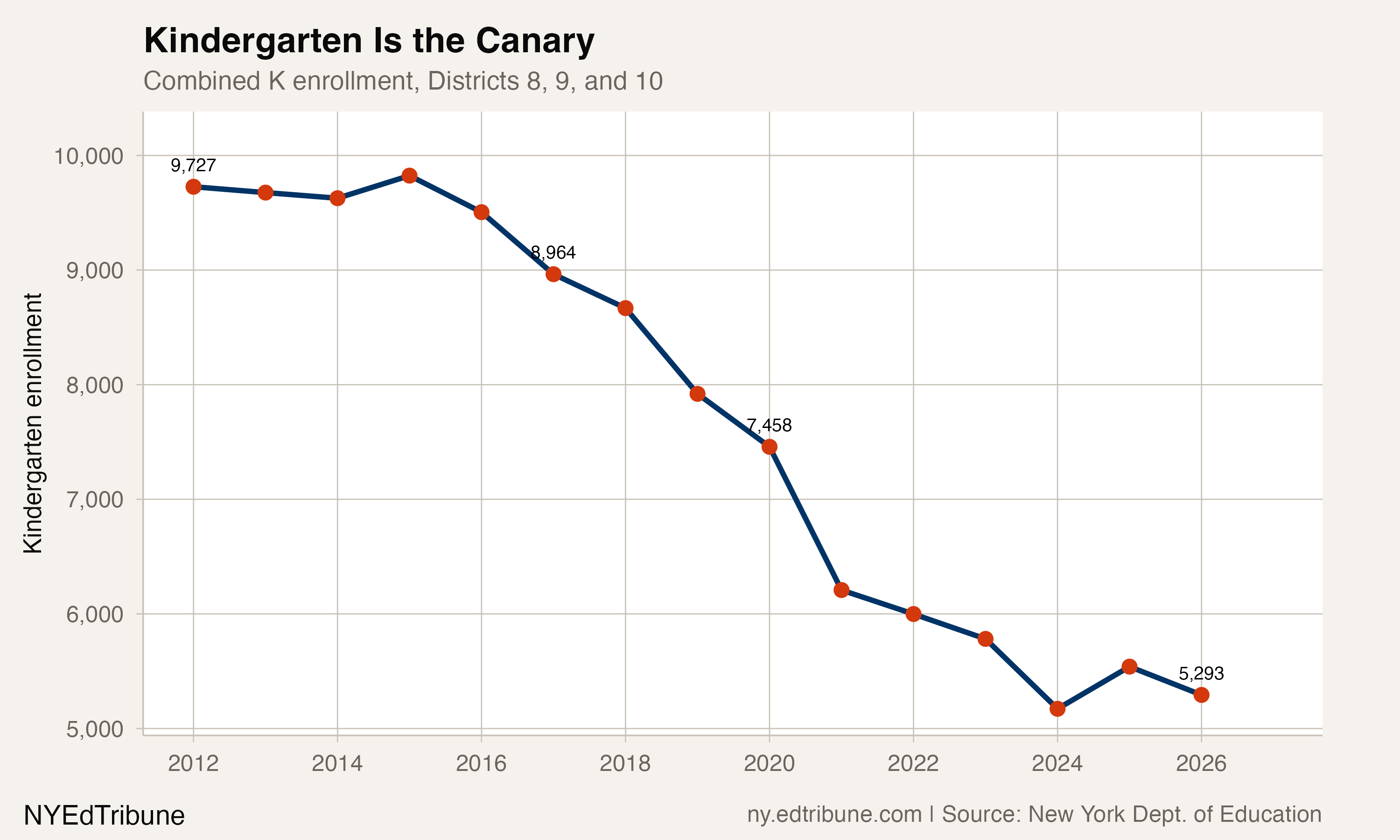
In 2012, these districts enrolled 137 kindergartners for every 100 twelfth-graders. In 2026, that ratio has flipped: 84 kindergartners for every 100 seniors. The grade pipeline has inverted. High school enrollment, built on cohorts that entered kindergarten a decade ago, now exceeds the incoming elementary cohorts that will define these districts' size for the next 13 years.
What is driving the contraction
No single force explains a 30.8% decline across three districts in 14 years. Several overlapping pressures are at work.
Charter school growth has drawn families out of district schools. The Empire Center for Public Policy documented that the Bronx saw the largest enrollment drop among NYC boroughs over the five years from 2019-20, losing more than a fifth of its students from 174,830 to 139,305. Statewide, charter enrollment grew 2.9% to 186,458 students in 2024-25 even as district enrollment continued to fall. In the Bronx, where district and charter schools serve overlapping populations in some of the city's poorest neighborhoods, each charter seat gained is likely a district seat lost.
Housing displacement is a second pressure. A Bronx Times analysis found that eight of the Bronx's 12 community districts rank in the top 10 citywide for affordable housing threats. The areas overlapping Districts 9 and 10, including Fordham, Belmont, and Kingsbridge, have threat scores exceeding 20, higher than any non-Bronx district. Prior to the pandemic, the Bronx had the highest concentration of rent-burdened households in the city, with 56% paying more than 30% of income toward rent.
"We need to define what it means to be affordable in respect to people and their wages." -- Julie Colon, Northwest Bronx Community & Clergy Coalition, via Bronx Times (May 2023)
Declining birth rates provide a third explanation. Empire Center research notes that the combination of declining fertility, net domestic outmigration, and reduced lawful immigration pushed New York's school-age population from nearly 3.5 million in 2000 to around 3 million. The kindergarten collapse in these districts, with K enrollment down 45.6%, is consistent with sharply smaller incoming cohorts, not just families choosing other schools.
The broader Bronx picture
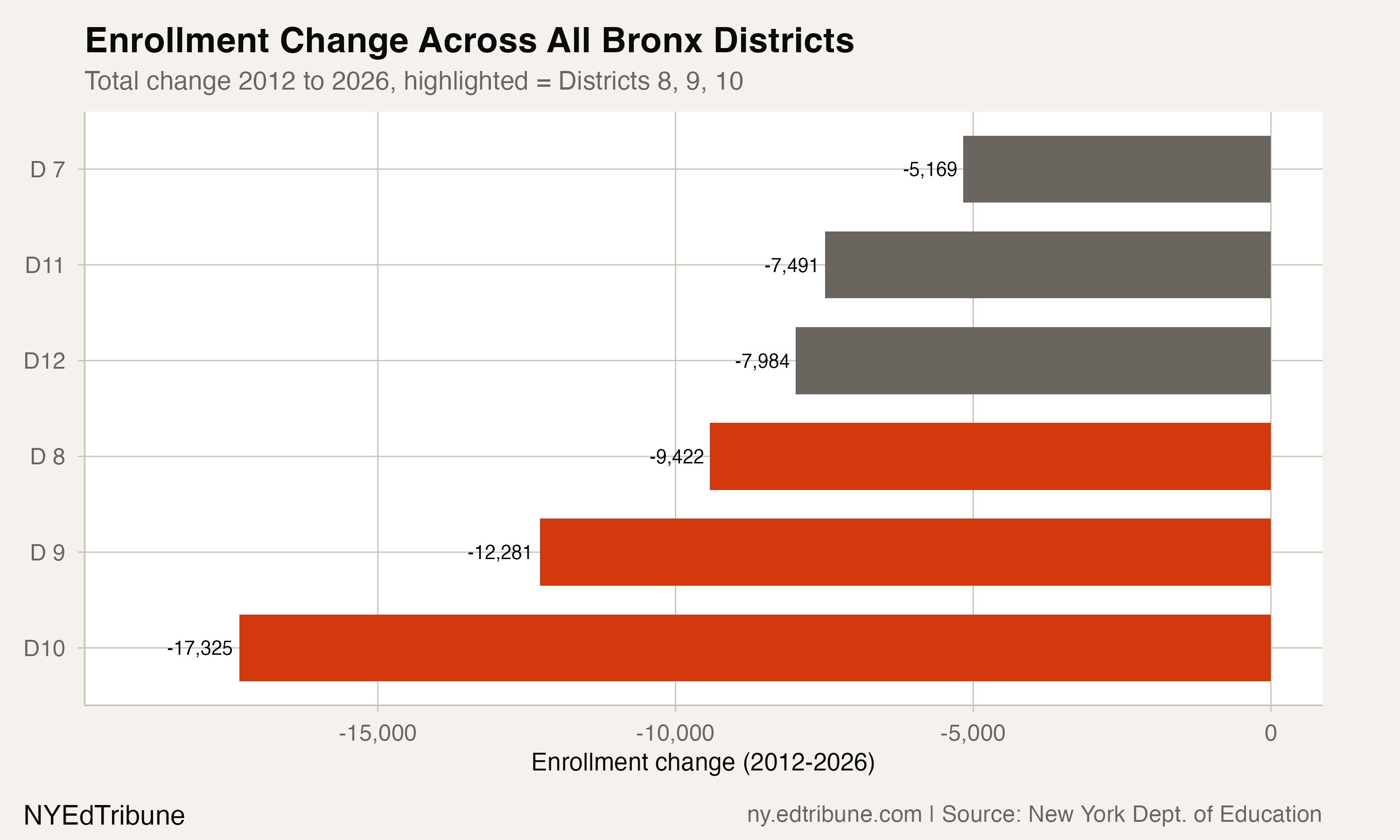
Every Bronx geographic district lost enrollment over this period. District 12 (Williamsbridge, Wakefield) fell 33.2%, matching District 9 as the steepest percentage decline. District 7 (Mott Haven, Hunts Point) lost 27.1%. Even District 11 (Pelham Parkway, Morris Park), which has historically been more stable, shed 19.2%.
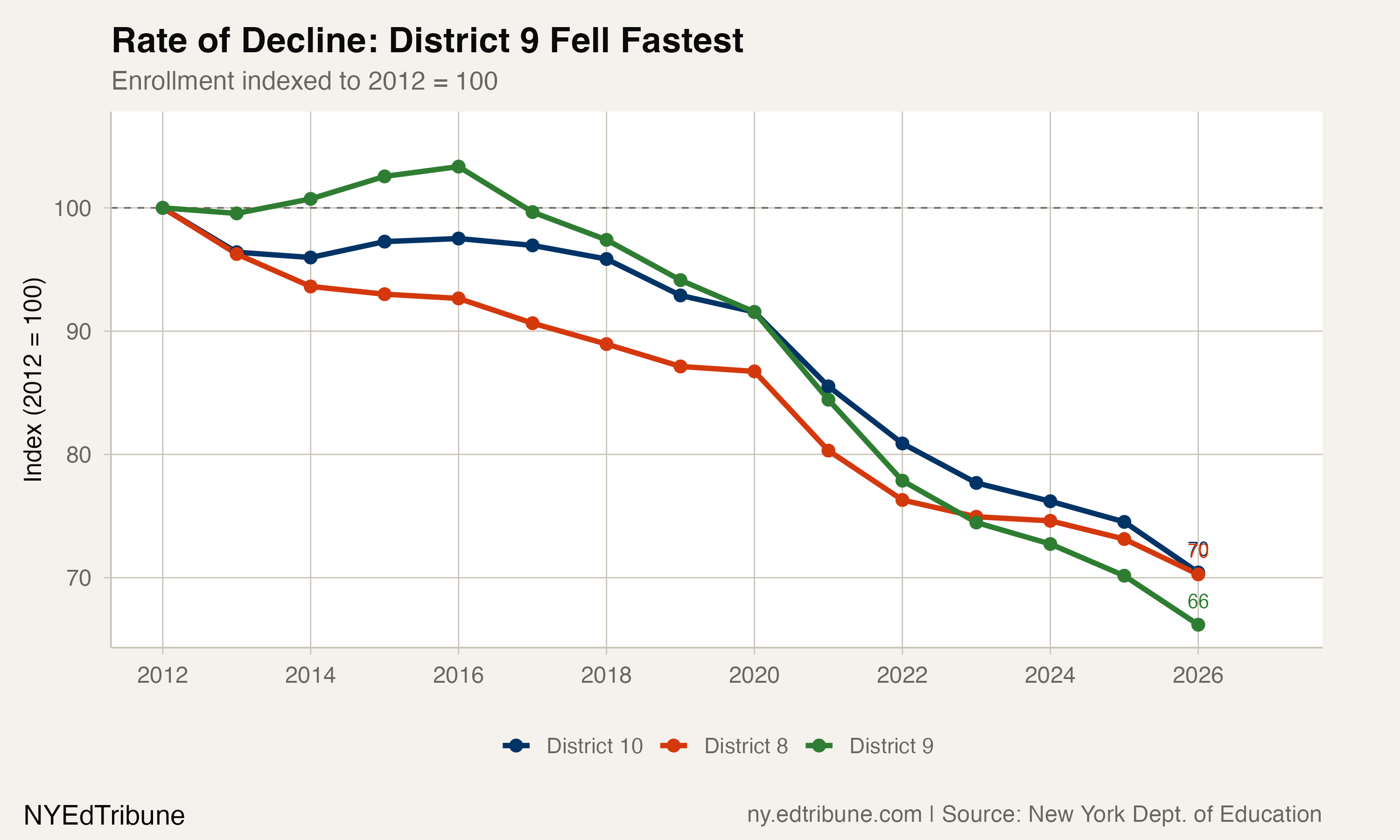
The convergence is striking. By 2026, all three focus districts are clustered between 66 and 70 on an index where 2012 equals 100. They began at very different sizes but are declining at nearly identical rates.
What mergers signal
Schools in these districts are increasingly too small to sustain full programming. Chalkbeat reported that roughly two-thirds of the 35 school merger, closure, or grade-removal proposals approved citywide over six years were in the Bronx or Brooklyn. The number of NYC schools with fewer than 200 students doubled from 81 in 2016 to 190, and projections suggest NYC enrollment could fall by another 200,000, or 26%, over the next decade.
"Proposals to consolidate schools are not being generated top down. They really are coming from communities and superintendents." -- Dan Weisberg, NYC First Deputy Chancellor, via Chalkbeat (Oct. 2024)
The city's hold-harmless policy has shielded schools from immediate budget cuts tied to enrollment shortfalls. In 2025-26, schools would have collectively returned over $250 million without the policy. But hold-harmless funding has relied on non-recurring COVID stimulus dollars that are now exhausted. Schools Chancellor Melissa Aviles-Ramos acknowledged the challenge: "We're committed to providing stability and ensuring every school has the resources it needs."
What comes next
The kindergarten pipeline suggests no reversal is coming. With K enrollment at 5,293 and still falling, these districts are locking in further total enrollment declines for years to come, regardless of what happens to migration patterns or charter competition. Even if kindergarten enrollment stabilized tomorrow, the current K cohort is 46% smaller than the graduating 12th-grade cohort it will eventually replace.
Two-thirds of the school merger proposals that NYC approved over six years landed in the Bronx or Brooklyn. Chalkbeat projects another 200,000 students could leave the city over the next decade. For Districts 8, 9, and 10, which have already lost 39,000, the hold-harmless policy buys time but not students. Somewhere in Morrisania or Throgs Neck, a school built for 500 children is serving 250, and the kindergarten class walking in September 2026 will be smaller than the one that walked in for 2025-26.
Detailed code that reproduces the analysis and figures in this article is available exclusively to EdTribune subscribers.
Discussion
Sign in to join the discussion.
Loading comments...