Correction (April 12, 2026): An earlier version of this article understated NYC District 75's share of statewide enrollment as less than 0.2%; the correct figure is about 1.2%. It also overstated the 2024 enrollment decline outside New York City as 5,519; the correct figure is 3,106.
Part of the New York Enrollment 2026ET series.
Five years after COVID emptied New York's classrooms, the students have not come back. Of 722 districts that can be tracked from 2019 to 2026, just 101, or 14.0%, have returned to their pre-pandemic enrollment. The other 621 districts are still underwater, collectively missing 263,494 students. Nearly nine in ten New York public school students, 89.7%, attend a district that has fewer children than it did before the pandemic.
That 14% figure is not an artifact of small-district churn. Only one of New York's 41 districts with 10,000 or more students has recovered. Among the 67 mid-size districts (5,000 to 9,999), just seven have matched their 2019 levels. The non-recovery is most severe where the most students live.
The recovery that never arrived
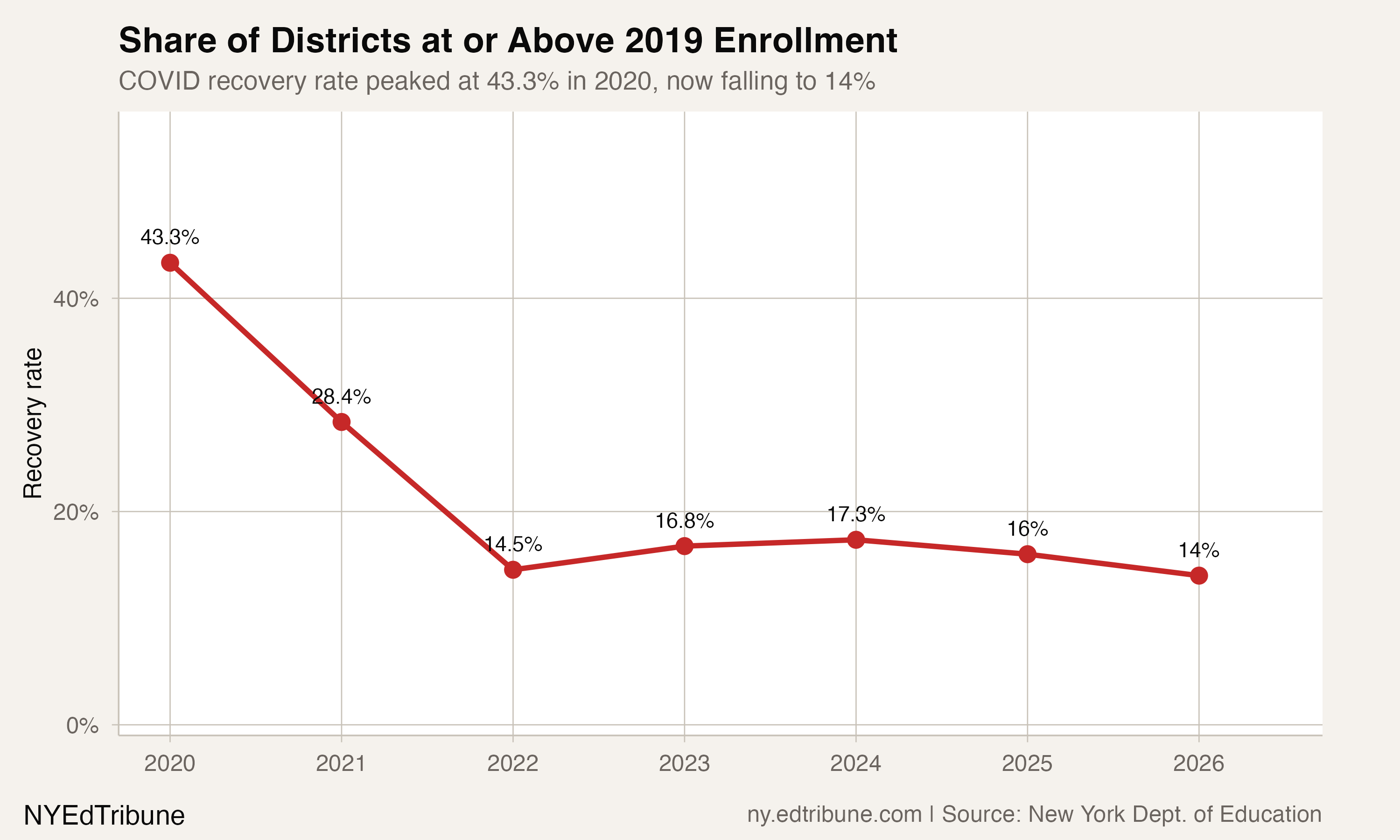
The first year of data after 2019 suggested the losses might be temporary. In 2020, 43.3% of districts still matched or exceeded their 2019 totals, reflecting that COVID's initial impact was concentrated in certain regions. Then the bottom fell out. By 2021, the recovery rate dropped to 28.4%. By 2022, it was 14.5%.
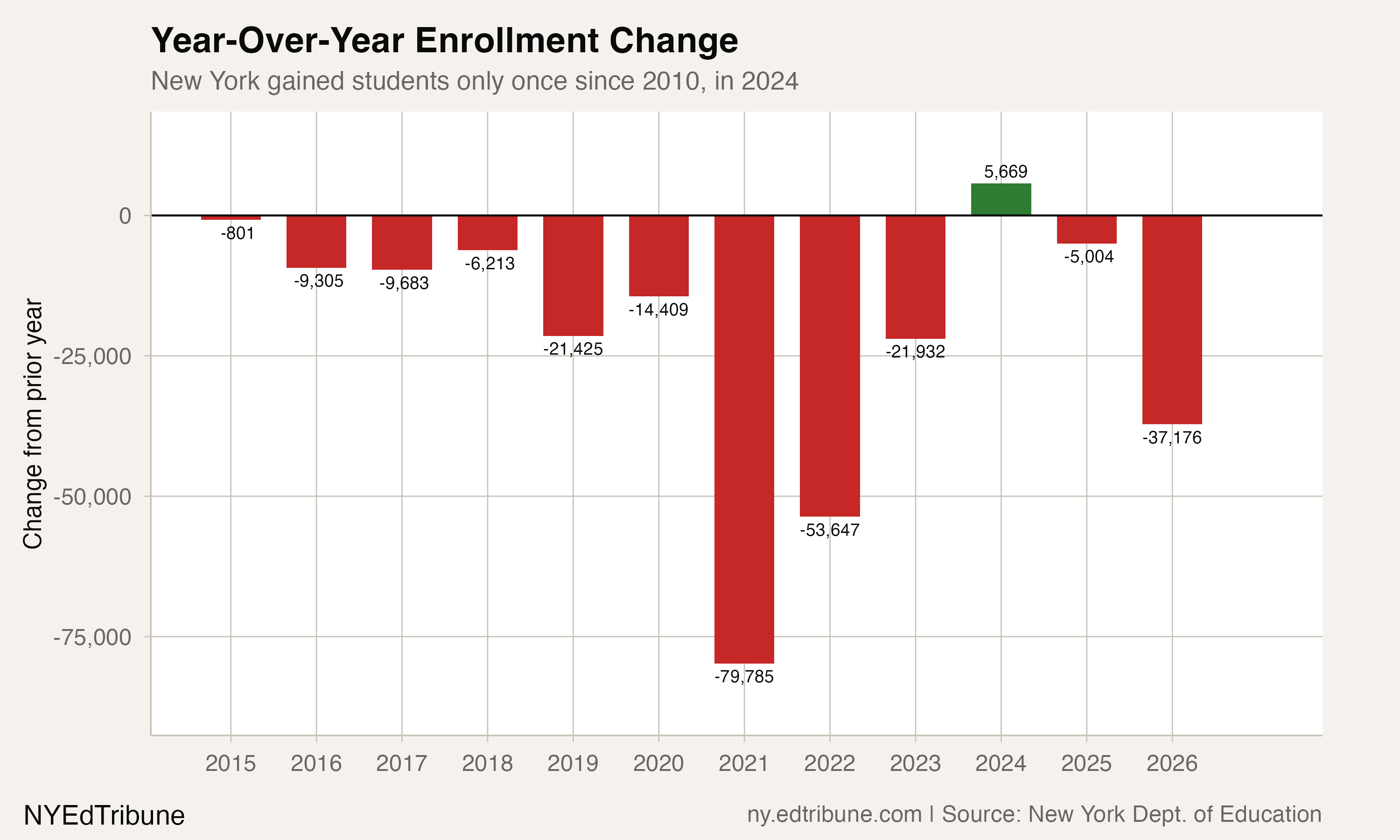
A brief plateau followed: 16.8% in 2023 and 17.3% in 2024, the year a migrant-enrollment surge in New York City temporarily slowed the statewide decline. The state added 5,669 students that year, the only growth since 2010. The plateau broke in 2025 (16.0%) and collapsed further to 14.0% in 2026.
Statewide, enrollment fell from 2,653,358 in 2019 to 2,447,074 in 2026, a loss of 206,284 students (-7.8%). The 2025-2026 single-year drop of 37,176 students (-1.5%) is the largest outside the pandemic itself.
Fourteen of the 15 worst losses are in New York City
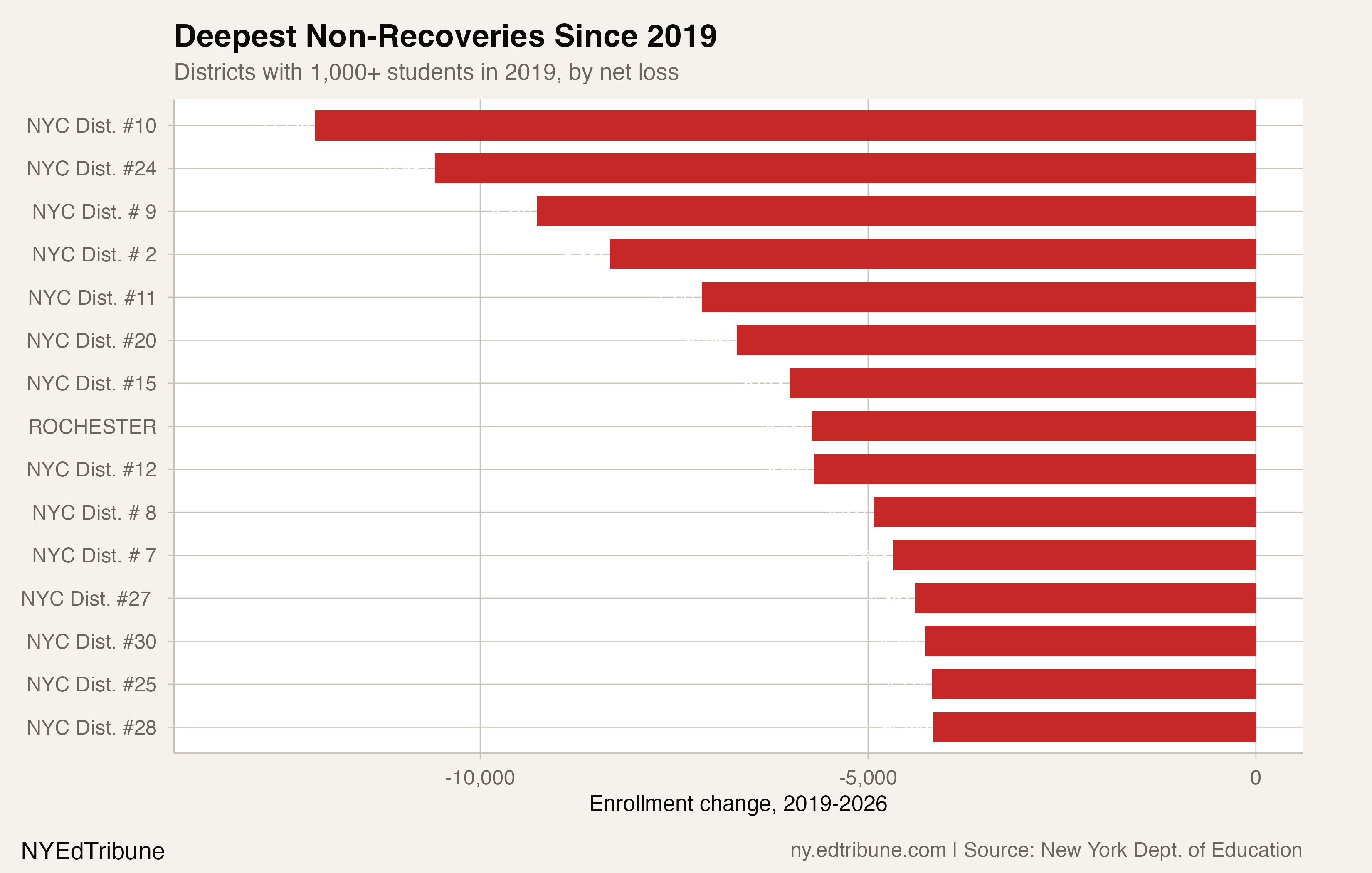
The Bronx alone accounts for four of the five deepest non-recoveries. NYC Geographic District #10↗ET lost 12,129 students since 2019, a 23.5% decline. District #24 in Queens↗ET lost 10,582 (-18.9%). District #9 in the Bronx↗ET lost 9,270 (-28.7%). District #2 in Manhattan↗ET lost 8,332 (-13.6%).
| District | 2019 | 2026 | Change | Pct. |
|---|---|---|---|---|
| NYC Dist. #10 (Bronx) | 51,648 | 39,519 | -12,129 | -23.5% |
| NYC Dist. #24 (Queens) | 56,098 | 45,516 | -10,582 | -18.9% |
| NYC Dist. #9 (Bronx) | 32,299 | 23,029 | -9,270 | -28.7% |
| NYC Dist. #2 (Manhattan) | 61,267 | 52,935 | -8,332 | -13.6% |
| NYC Dist. #11 (Bronx) | 37,026 | 29,885 | -7,141 | -19.3% |
| NYC Dist. #20 (Brooklyn) | 49,743 | 43,051 | -6,692 | -13.5% |
| NYC Dist. #15 (Brooklyn) | 31,262 | 25,249 | -6,013 | -19.2% |
| Rochester | 26,947 | 21,216 | -5,731 | -21.3% |
Rochester↗ET is the lone upstate entry in the top eight, losing 5,731 students (-21.3%). Outside the city, Hempstead↗ET on Long Island lost 2,608 students (-35.9%), the steepest percentage decline among districts with over 1,000 students.
Overall, NYC's 52 geographic and special districts posted a 25.0% recovery rate, with 13 of 52 recovering. Outside the city, 88 of 670 districts (13.1%) recovered. NYC's higher recovery rate reflects the migrant-enrollment boost that temporarily lifted some districts above their 2019 baselines before reversing in 2025-2026.
Size and vulnerability
The pandemic inverted the usual relationship between district size and stability. The smallest districts, those with fewer than 100 students in 2019, posted the highest recovery rate: 41.2% (7 of 17). Many are charter schools that opened seats or expanded grade bands after 2019. Districts with 100 to 499 students recovered at 20.0%.
At the other end, districts with 10,000 or more students recovered at just 2.4%, or one of 41. That single district, NYC District 75, enrolled 29,975 students in 2026, about 1.2% of the state's total. The structural pattern: the larger the district, the worse the non-recovery.
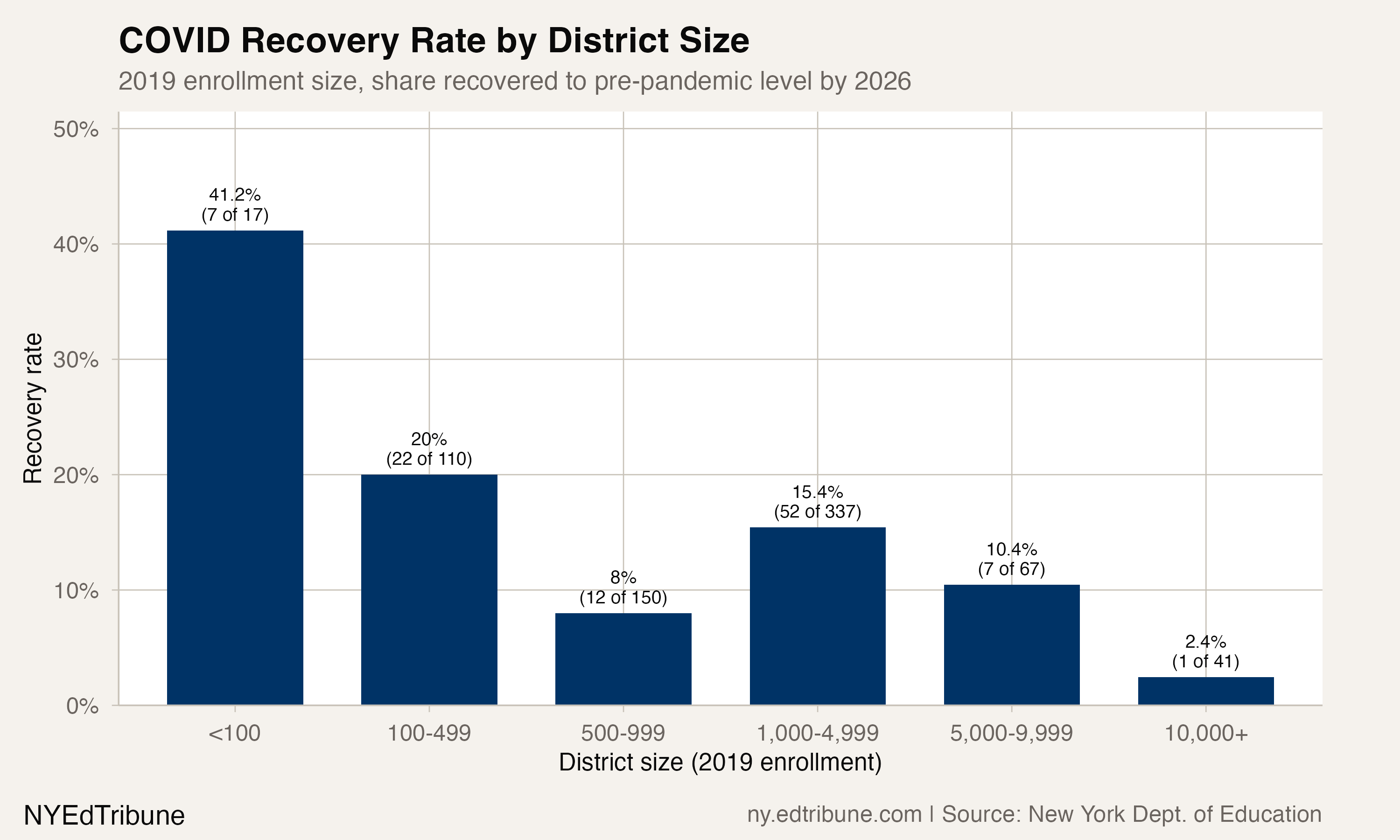
This size gradient means the non-recovery concentrates where students actually are. Districts that have not recovered enrolled 2,017,495 students in 2026. Recovered districts enrolled just 232,443.
The migrant boom and its reversal
The 2024 enrollment uptick, the only growth year since 2010, was driven almost entirely by migrant enrollment in New York City. Between spring 2022 and December 2024, the city received 225,700 asylum seekers, and over 36,000 students in temporary housing enrolled in NYC public schools.
That surge masked what was happening everywhere else. Even in the "growth" year of 2024, charter schools gained 5,938 students while traditional public schools lost 269. Outside NYC, enrollment fell by 3,106 students.
The reversal came fast. Chalkbeat reported that at 60 schools that absorbed the most migrant students, enrollment fell 11% in a single year, wiping away years of gains. ATLAS, a Queens school that peaked at 1,428 students during the migrant influx, dropped to 829, a 42% decline over two years.
"That means major cuts to federal funding and difficult decisions for the entire system." — Loredana Valtierra, Century Foundation fellow, Chalkbeat, Nov. 2025
The city's response to the enrollment drop has been fiscal, not programmatic. NYC chose not to claw back $250 million in midyear budget reductions from schools that fell below projected enrollment, holding nearly two-thirds of the city's roughly 1,600 schools harmless despite having fewer students than expected.
Where the missing students went
The pandemic accelerated an exit from New York's traditional public school system that has not reversed. Between 2019 and 2026, charter school enrollment grew from 147,428 to 190,105, a gain of 42,677 students (+28.9%). Traditional public schools lost 248,961 students (-9.9%) over the same period.
Homeschooling has also grown sharply. The Empire Center documented that homeschool enrollment jumped 178% over the past decade, the second-highest growth rate in the nation after Washington, D.C. In New York City alone, homeschooling tripled in 24 of 33 school districts since 2017-2018, reaching 53,967 students statewide.
But these alternative enrollments do not fully explain the gap. Charter enrollment alone grew by 42,677 since 2019, and homeschool enrollment has surged, but together they do not account for a 206,284-student loss from public school rolls. Birth rate decline explains much of the remainder: New York State's fertility rate has tracked below the national average since before the pandemic, and kindergarten enrollment, the closest proxy for incoming cohort size, has fallen from 188,203 in 2019 to 163,820 in 2026, a 13.0% decline. Net domestic outmigration, a persistent feature of New York's demographics since at least 2020, compounds the picture.
A funding formula that doesn't see the loss
New York's Foundation Aid formula distributes $35.9 billion annually to public school districts. A "hold harmless" provision prevents any district's allocation from declining year-to-year, regardless of enrollment. In fiscal year 2025, half of all districts, 334 of 668, would have faced Foundation Aid reductions without this protection.
The Rockefeller Institute recommended phasing out the provision in its 300-page review of the formula. Governor Hochul's office rejected the idea, stating the governor "believes we should avoid proposals that would negatively impact school budgets." The formula continues to rely on data from the 2000 Census for poverty calculations, though a 2025 budget change replaced this with a three-year rolling average called SAIPE.
The policy question is whether hold harmless, designed as a temporary cushion, has become a permanent subsidy for districts whose enrollment may never return.
The trajectory gap
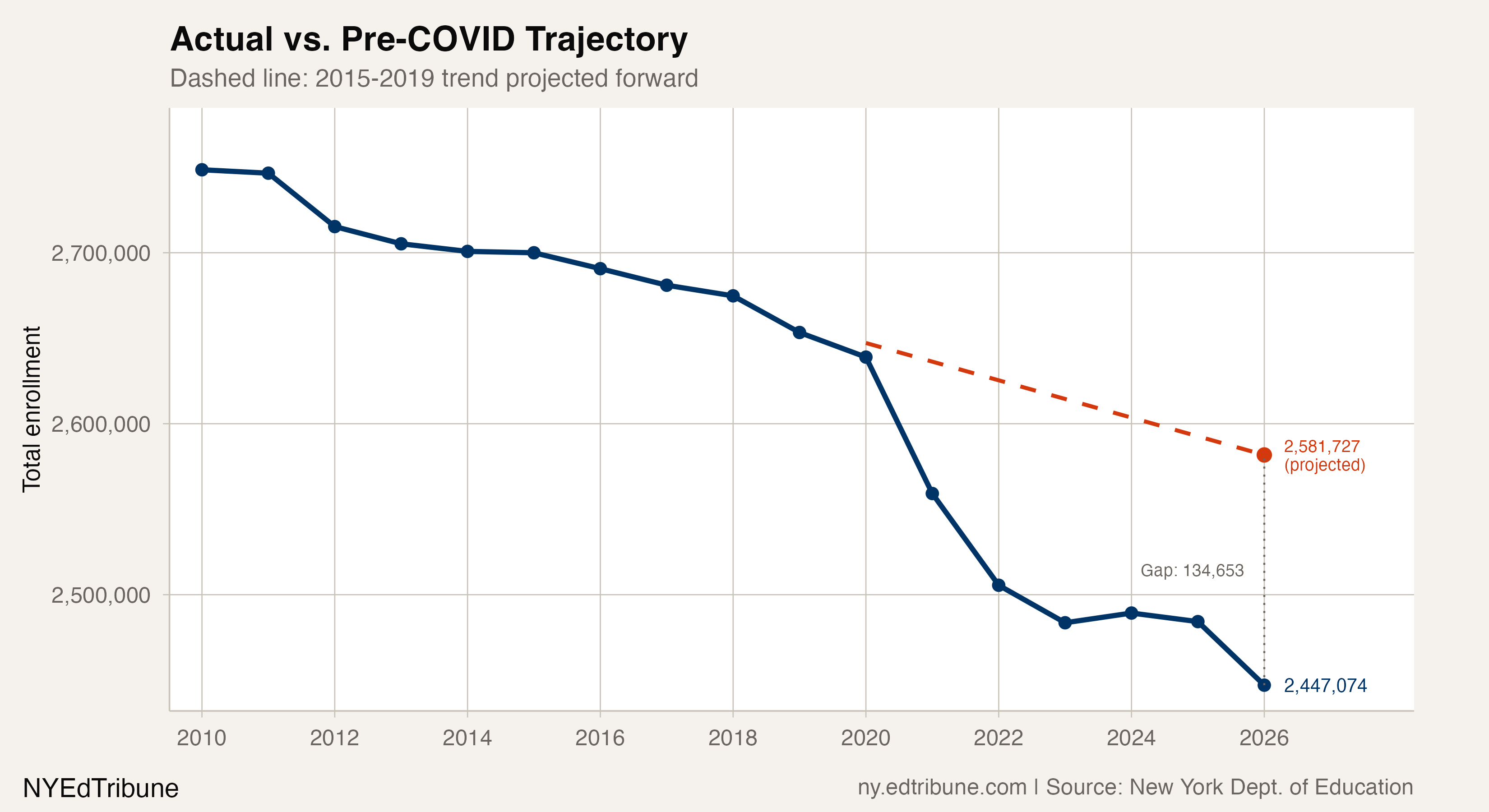
Projecting New York's 2015-2019 decline rate forward, enrollment in 2026 would have been approximately 2,581,727. The actual figure of 2,447,074 leaves a gap of 134,653 students, the excess loss attributable to the pandemic and its aftermath beyond what the pre-existing decline trajectory predicted.
That 134,653-student gap is not recoverable through normal demographic patterns. Kindergarten cohorts are shrinking, the migrant enrollment boost has reversed, and homeschool growth shows no sign of slowing. The 2027 kindergarten class, born during the pandemic's lowest birth year, will enter a system already 206,284 students below its 2019 level. For 621 districts still underwater, the question is no longer when recovery arrives. It is how schools designed for classrooms of 25 operate with classrooms of 18, how districts built for growth manage sustained contraction, and whether a funding formula that holds everyone harmless can survive a generation of decline.
Detailed code that reproduces the analysis and figures in this article is available exclusively to EdTribune subscribers.
Discussion
Sign in to join the discussion.
Loading comments...