Part of the New York Enrollment 2026ET series.
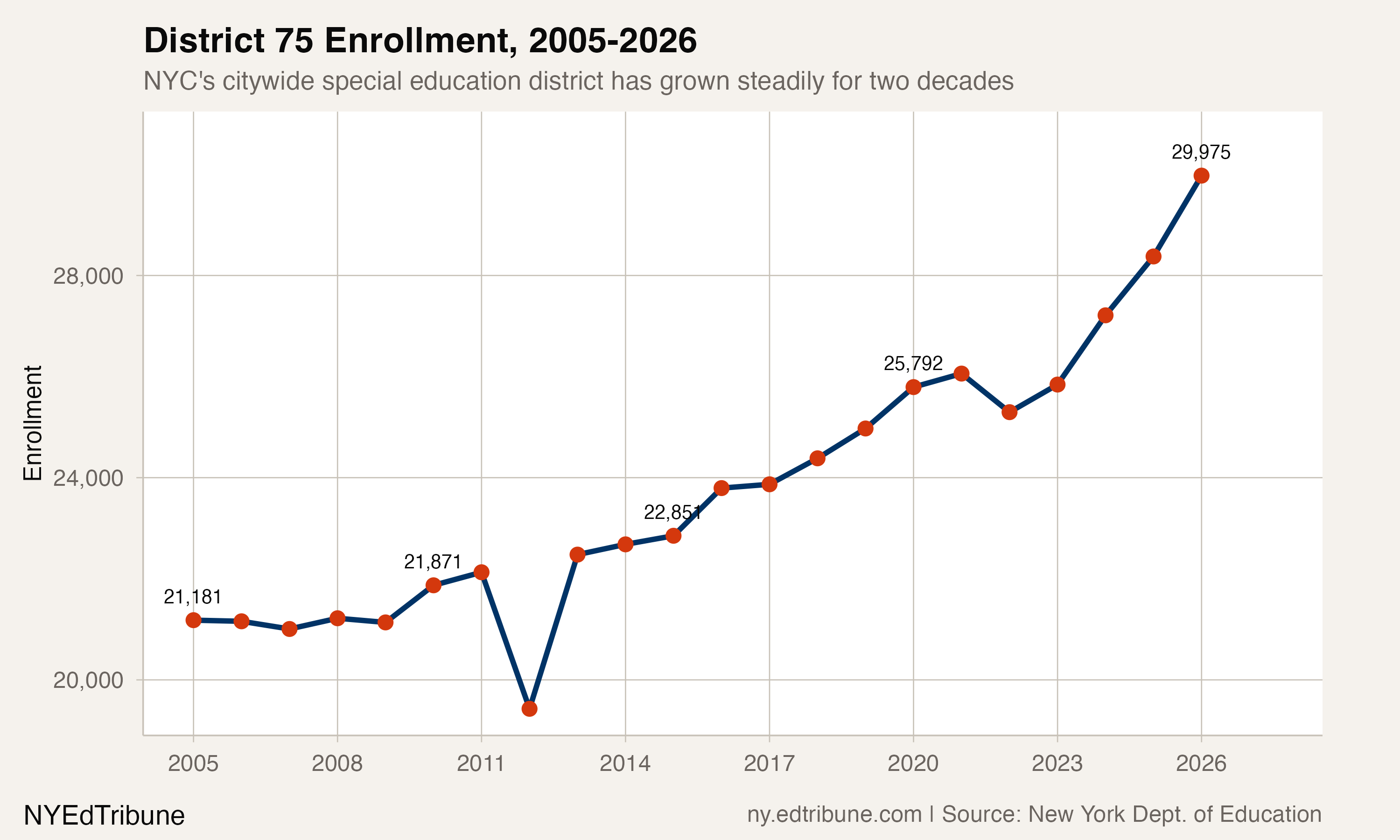
New York City lost 223,115 public school students between 2005 and 2026, a 22.2% decline that touched every borough and nearly every geographic district. One entity moved in the opposite direction. District 75↗ET, the citywide system that serves students with significant disabilities across all five boroughs, grew from 21,181 students to 29,975 over the same period, a 41.5% increase.
That 8,794-student gain is larger than the total enrollment of all but about 60 districts in New York State. District 75 is now the state's 11th-largest district entity, bigger than Buffalo. And the growth is accelerating: District 75 added 1,599 students in 2026 alone, a 5.6% one-year gain that is its largest ever.
A two-decade surge
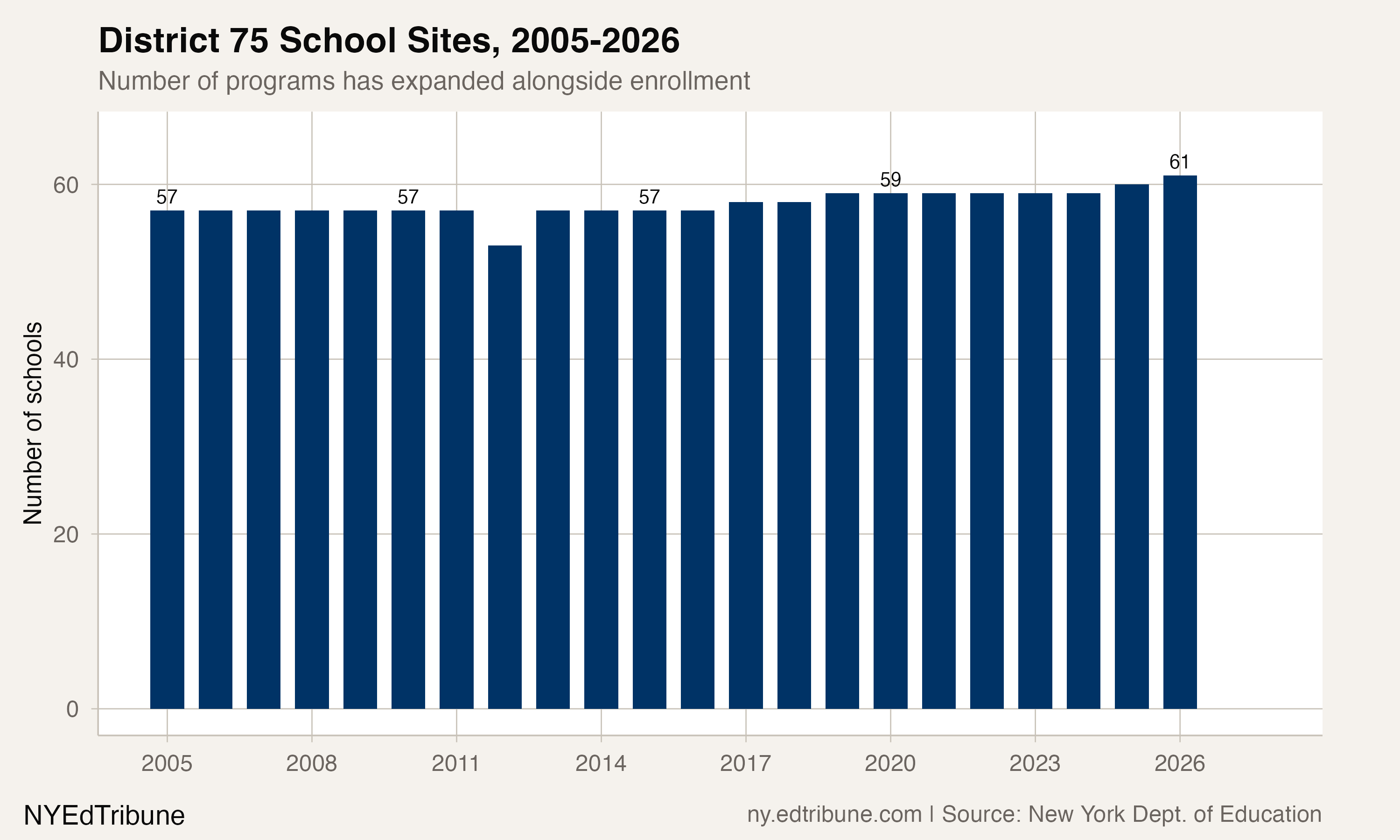
District 75 operates 61 school sites across all five boroughs, serving students with autism spectrum disorders, significant cognitive delays, emotional disturbances, and other disabilities that require specialized instructional settings. It is not a geographic district. Students are referred from across the city based on their Individualized Education Programs.
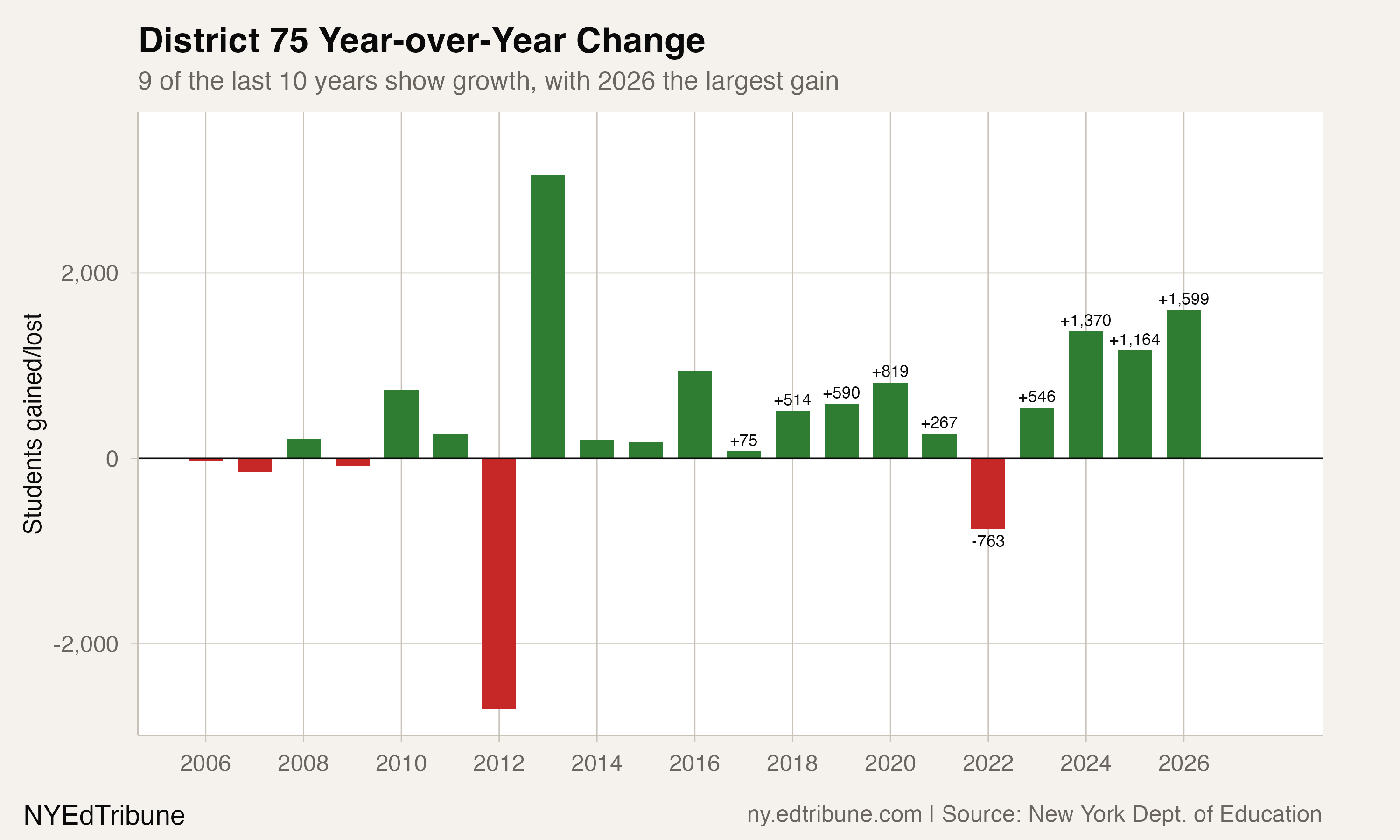
The trajectory has been remarkably consistent. From 2013 through 2026, District 75 grew in 13 of 14 years. The only interruption came in 2022, when enrollment dipped by 763 students, likely a delayed pandemic effect as some families with medically fragile children were slower to return to in-person instruction. By 2023, the trajectory resumed. Over the last three years, District 75 has added 4,133 students, a 16.0% surge.
The growth accelerated after 2016. From 2005 to 2016, District 75 gained 2,613 students in 11 years. From 2016 to 2026, it gained 6,181 in 10 years, nearly triple the pace. The most recent three-year run of gains, 1,370 in 2024, 1,164 in 2025, and 1,599 in 2026, represents the fastest sustained expansion in the dataset.
(A note on the data: 2012 shows a sharp one-year dip to 19,428, followed by a rebound to 22,478 in 2013. This coincides with a statewide reporting change in how NYSED categorized school entities. Four fewer D75 school sites appear in the 2012 file. The dip is a data artifact, not a real enrollment change, and the 2012-2013 year-over-year figures should be read with that context.)
Growing while everything else contracts
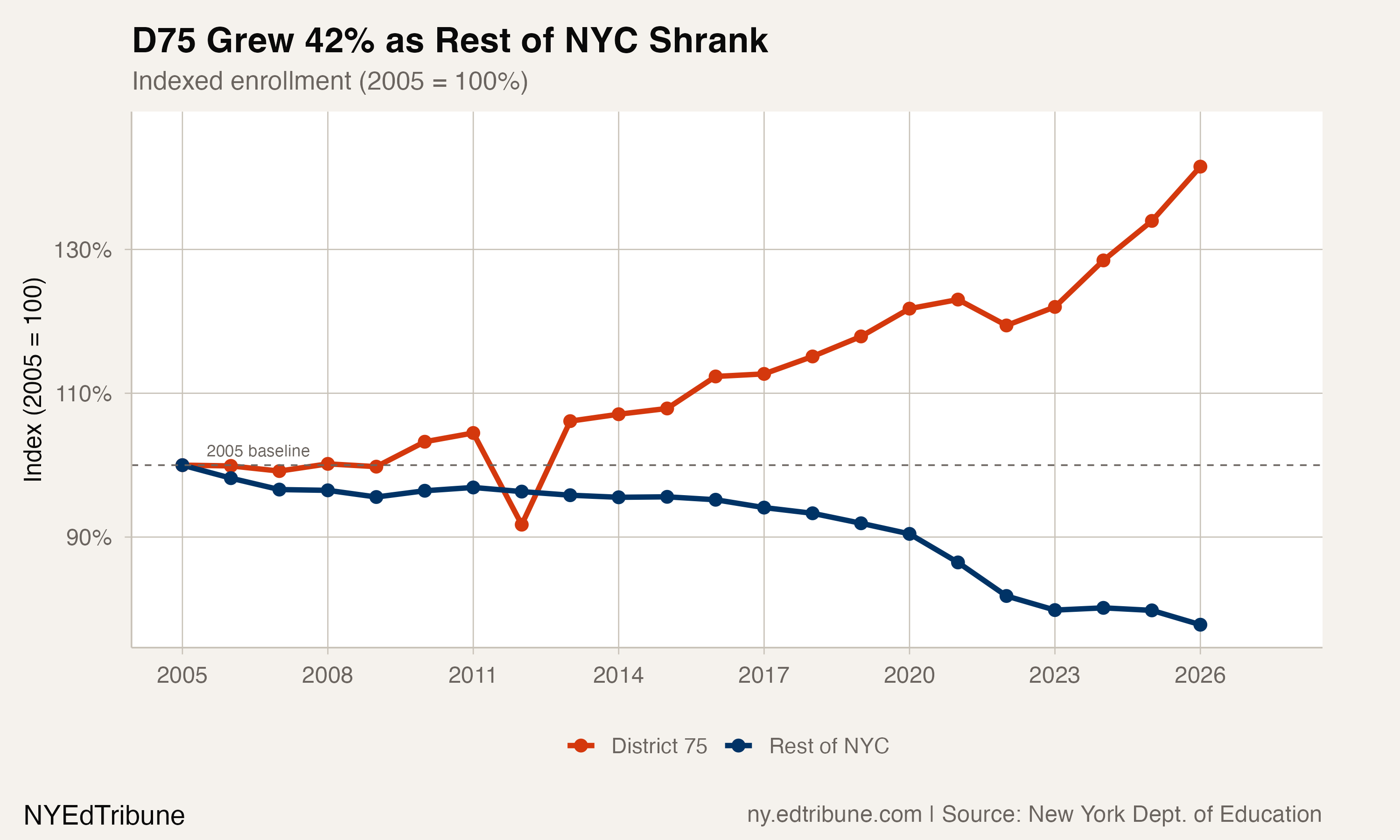
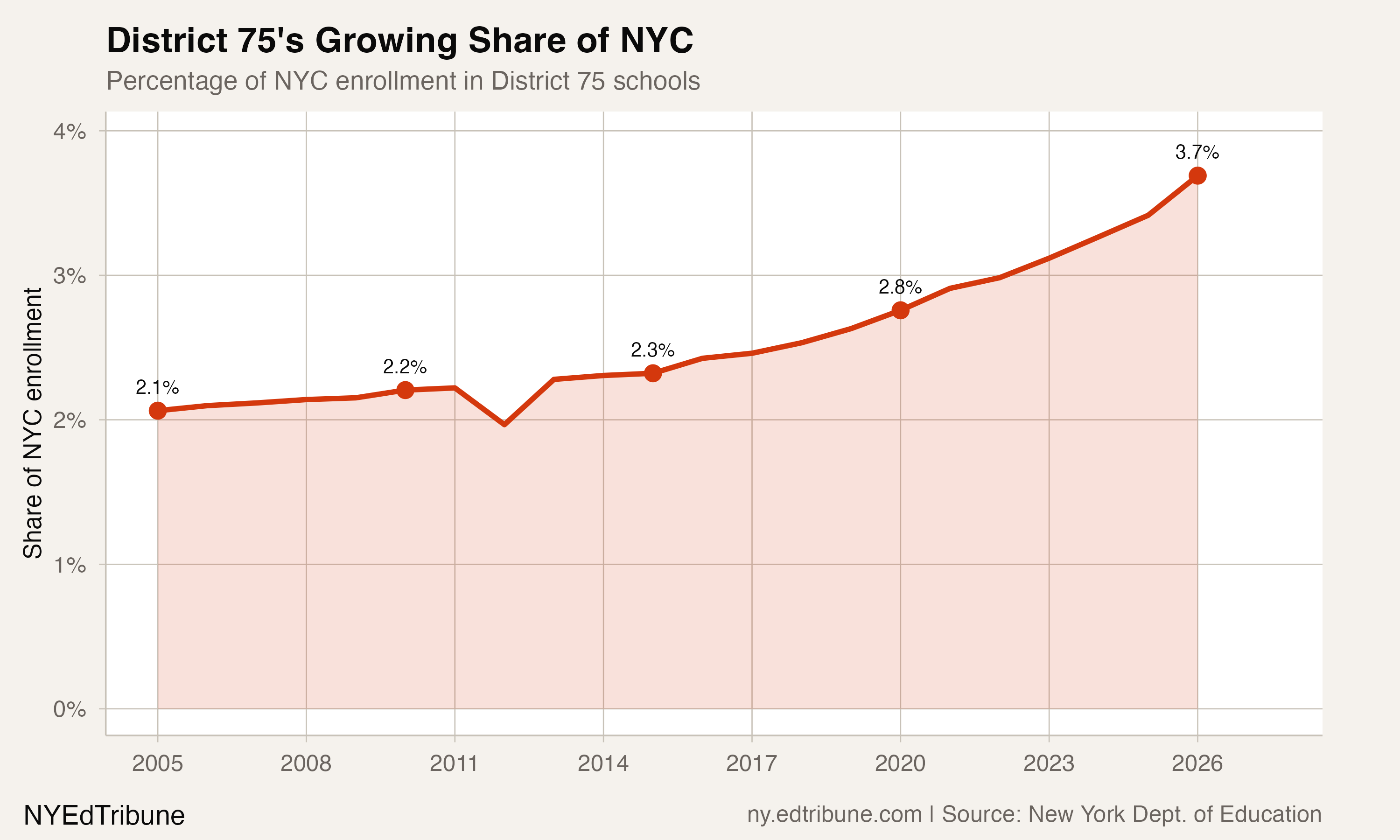
The divergence between District 75 and the rest of New York City is striking. Since 2005, the rest of NYC's public schools lost 223,115 students, a 22.2% decline. District 75's share of NYC enrollment nearly doubled, from 2.1% to 3.7%. Put differently: in 2005, roughly one in every 48 NYC public school students attended a District 75 program. In 2026, it is one in every 27.
The rest of the state fared no better. Excluding District 75, New York's remaining districts and schools lost 403,778 students since 2005, a 14.3% decline. District 75 grew through the period when everything around it contracted, including through COVID. Between 2020 and 2021, when NYC schools experienced their steepest pandemic losses, District 75 still added 267 students.
What is driving the growth
The enrollment data alone cannot distinguish between two fundamentally different explanations: more children with significant disabilities arriving in New York City schools, or more children already enrolled being identified and referred to District 75 programs. Both are almost certainly contributing, though the data points more toward identification.
New York has the highest special education identification rate in the nation at 19.2%, 40 percent above the national average of 13.7%. More than 200,000 NYC students have IEPs, approximately 19% of the city's student body, compared with 14% in Chicago, 12% in Los Angeles, and 7% in Houston. Students with disabilities in New York are 2.7 times less likely than the national average to be reclassified out of special education, meaning that once a student enters the system, they tend to stay.
Nationally, special education enrollment hit 7.5 million students in 2022-23, an all-time high representing 15% of all public school students, up from 13% a decade earlier. The CDC reported in April 2025 that autism prevalence has risen to 1 in 31 children, up from 1 in 54 in 2016 and 1 in 150 in 2000. Experts attribute most of the increase to improved screening and broader diagnostic criteria rather than a true increase in incidence, but the effect on school enrollment is the same: more children arrive at school with diagnoses that entitle them to specialized instruction.
The funding architecture
The Empire Center for Public Policy, a fiscal policy research organization, has argued that New York's funding formula creates structural incentives toward identification:
"New York's funding system has created perverse incentives that encourage school officials to place students in special education to draw increased revenues." — Empire Center, "Perverse Incentives, High Costs and Poor Outcomes"
The report notes that of $66.2 billion spent on K-12 education in New York in 2017-18, $15.8 billion went to special education instructional services, more than any other state. The uniform weighting formula provides equal per-pupil funding regardless of disability severity, which the Empire Center argues can incentivize districts to classify students for additional revenue.
Whether that incentive structure specifically drives District 75 growth is less clear. District 75 placements require an IEP recommendation and a Committee on Special Education referral, a multi-step process with its own bureaucratic friction. The more direct explanation may be simpler: as awareness of autism and other developmental conditions has grown, more parents are seeking evaluations, and more evaluations are resulting in IEPs that recommend District 75 placement.
NYC has been expanding capacity to meet the demand. In 2024, Chancellor David Banks announced expanded autism programs, adding new Autism Nest, Horizon, and AIMS programs across three districts. NYC's Office of District Planning has documented persistent seat deficits for District 75 programs across boroughs, particularly at the elementary and high school levels in the Bronx.
The capacity question
District 75 operated 57 school sites for most of the 2005-2015 period. By 2020, it had added two. By 2026, it has 61. The school count has grown by 7% while enrollment grew 42%, meaning average school size has increased substantially: from about 372 students per site in 2005 to 491 in 2026, a 32% increase in students per program.
That compression has real consequences. District 75 programs are not standard classrooms. Many operate with class sizes of six to twelve students, specialized staffing ratios, and therapeutic support services. Adding 120 students per site, on average, strains physical space and staffing in ways that are difficult to see in aggregate enrollment numbers but visible in the seat deficit data that NYC's Office of District Planning tracks annually.
What the enrollment data cannot show
This analysis relies on total enrollment counts from the NYSED enrollment data archive. The state data does not include race, gender, or special population subgroups at the district level, so it is impossible to determine from this data whether District 75's growth is concentrated among particular disability categories (autism, emotional disturbance, cognitive delays) or particular demographics. NYU's Research Alliance has documented significant racial disparities in NYC IEP rates: Black students are more than twice as likely as white students to have emotional disturbance classifications, while white and Asian students have higher autism diagnosis rates.
The enrollment data also cannot separate the effect of improved identification from actual increases in disability prevalence. If autism diagnoses have risen from 1 in 150 to 1 in 31 nationally over two decades, and if NYC's identification infrastructure is more developed than most cities, some of District 75's growth is inevitable. How much of the 42% increase reflects children who genuinely needed a D75 placement, and how much reflects children who, in an earlier era, would have stayed in general education classrooms without a formal referral, is unknowable from enrollment data alone.
District 75 added 1,599 students this year, its largest single-year gain ever. NYC's Office of District Planning already documents persistent seat deficits for D75 programs across boroughs, particularly at the elementary and high school levels in the Bronx. At the current pace, District 75 will cross 30,000 students by 2027. Chancellor Banks expanded autism programs in 2024 with new Nest, Horizon, and AIMS sites across three districts. But the gap between capacity and demand keeps widening. In a city that lost 223,000 students, the one system that cannot stop growing is the one that serves its most vulnerable children.
Detailed code that reproduces the analysis and figures in this article is available exclusively to EdTribune subscribers.
Discussion
Sign in to join the discussion.
Loading comments...