Part of the New York Enrollment 2026ET series.
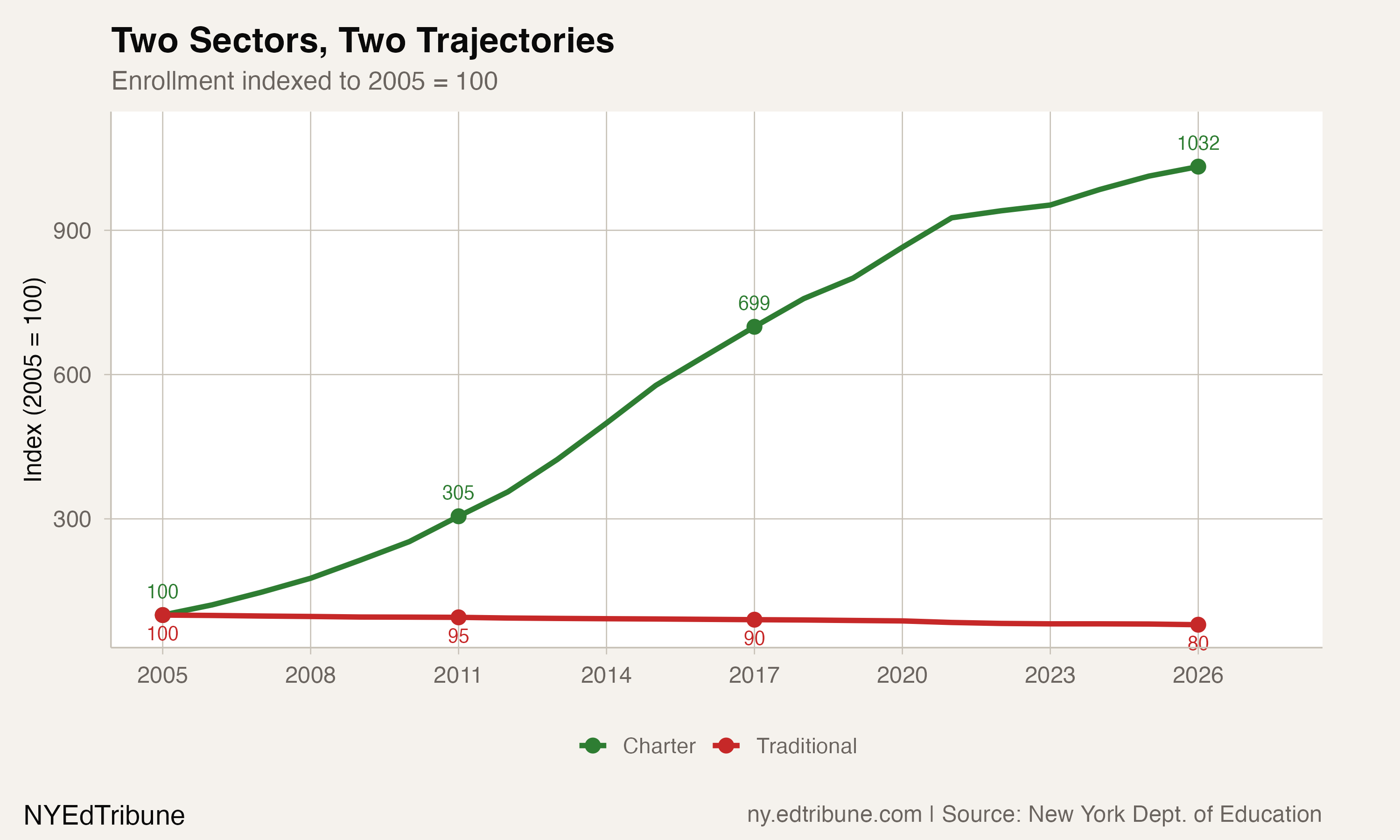
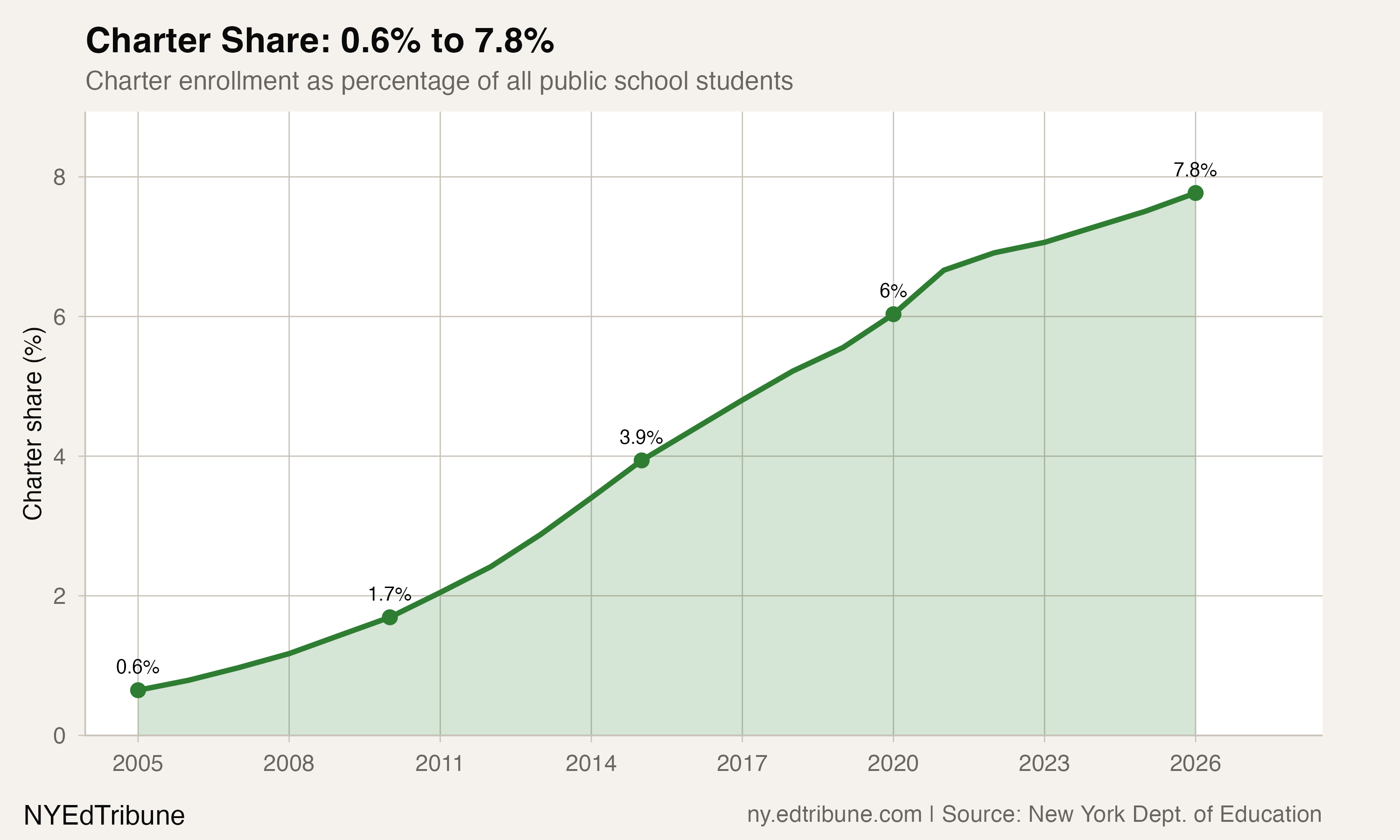
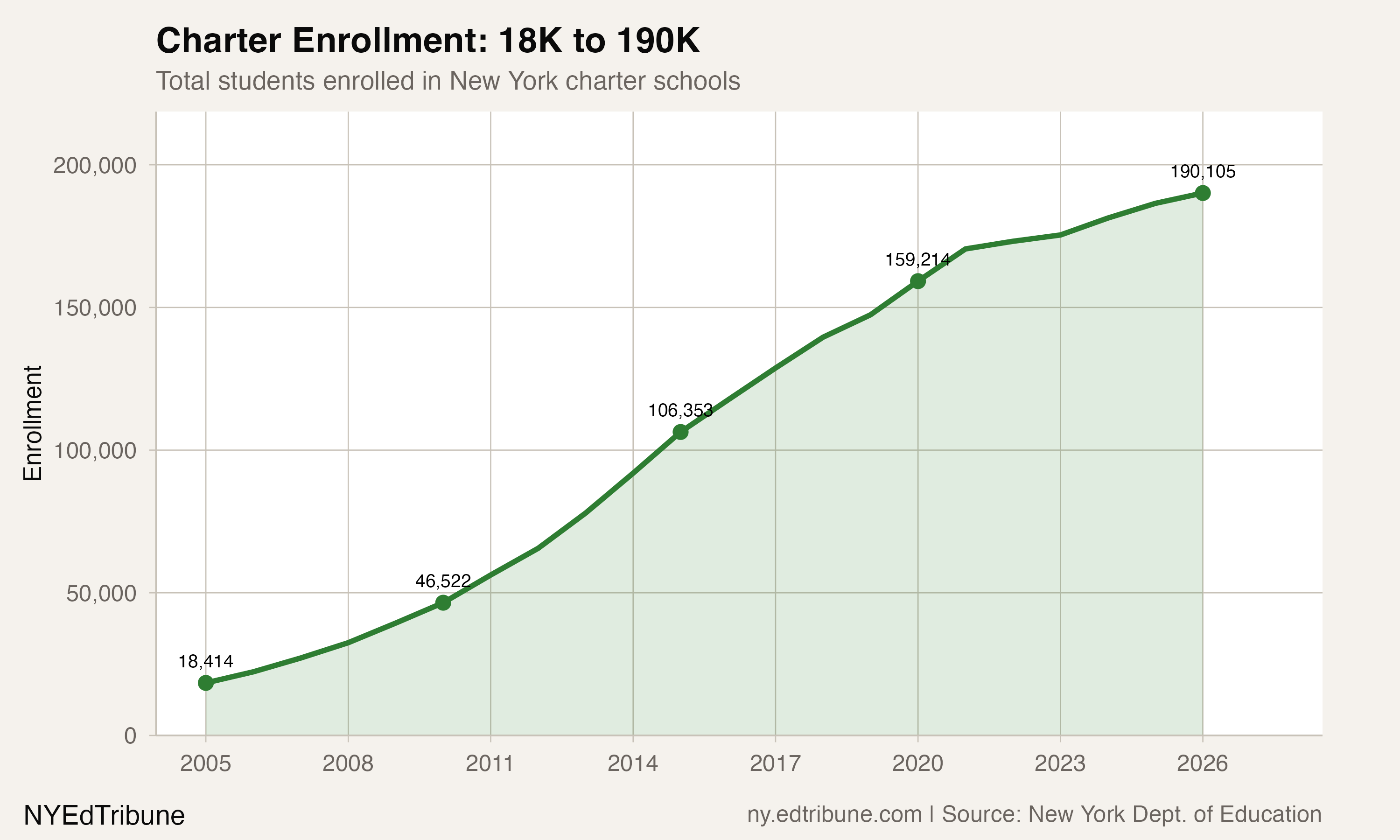
In 2005, New York's 61 charter schools enrolled 18,414 students, a rounding error in a system of 2.8 million. Twenty-one years later, 349 charter schools serve 190,105 students, 7.8% of the state's public enrollment. Over the same period, traditional public schools lost 566,675 students and have not grown in a single year since the data begins.
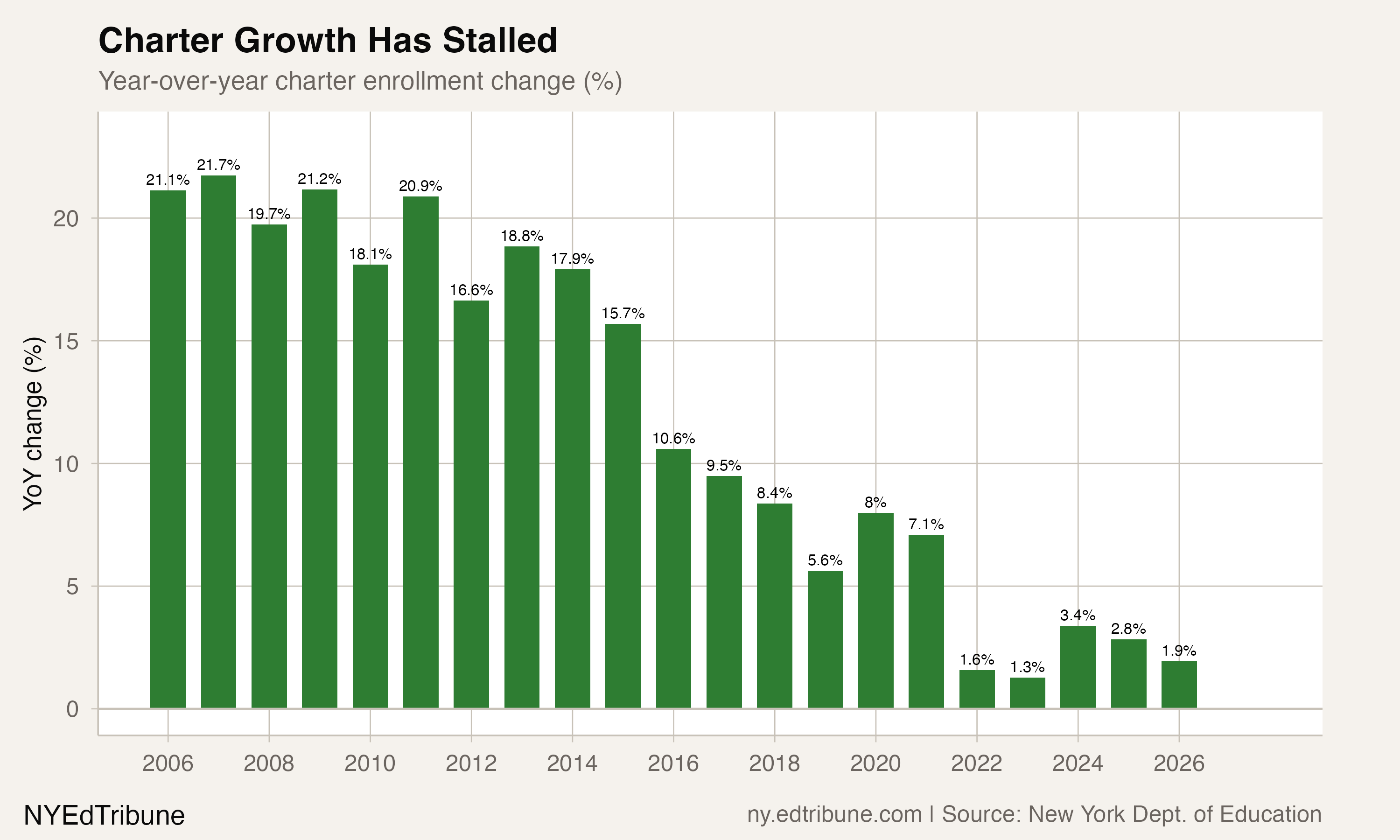
But the headline numbers obscure a more interesting story. Charter growth has decelerated so sharply that the sector is approaching a ceiling, adding just 1.9% in 2025-26 after averaging more than 20% annually in its first decade. The state's 460-school statutory cap, established in 2010, leaves roughly 108 authorizations unused, yet new openings have slowed to a trickle.
A 932% increase, concentrated in five boroughs
Charter enrollment grew from 18,414 to 190,105 between 2005 and 2026, a gain of 171,691 students. Traditional public schools lost 566,675 over the same period. Charter gains offset 30.3% of the traditional sector's losses. The remaining 70% reflects genuine enrollment decline driven by demographics, migration, and declining birth rates.
The divergence is overwhelmingly a New York City phenomenon. In 2026, charters serve 15.6% of NYC's 961,666 public school students, compared to just 2.7% of the 1,485,408 students in the rest of the state. NYC accounts for 150,131 of the state's 190,105 charter students, nearly 79% of the sector.
That concentration has reshaped the city's educational landscape. According to the NYC Charter School Center, 38% of Black elementary students in the city now attend charter schools. Across all grades, 90% of the city's charter students are Black or Latino.

Outside the five boroughs, charter schooling remains marginal. Sixty-four charter schools serve 39,974 students across the rest of New York, a share that has barely moved from 0.6% in 2005 to 2.7% in 2026. Rochester↗ET, Buffalo↗ET, Syracuse↗ET, and Albany↗ET have small charter sectors, but nothing approaching NYC's scale.
The growth engine is stalling
The charter sector's growth rate tells a story of three eras. From 2005 to 2011, annual growth averaged 20.5%, driven by rapid school openings. The sector tripled from 61 to 177 schools, adding roughly 6,300 students per year.
The second era, from 2011 to 2017, brought sustained double-digit growth at a 14.8% compound annual rate. Charter enrollment crossed 100,000 in 2015 and reached 128,784 by 2017.
Then the deceleration began. Growth slowed to 7.3% annually from 2017 to 2020, and has dropped to 3.0% since. In the most recent three years, the compound rate is 2.7%, indistinguishable from natural growth. The sector added 3,626 students in 2025-26, the smallest gain since 2022.
The entity count tells the same story from a different angle. After adding 25 new schools in 2020 alone, the pace dropped to single digits. In 2025-26, the charter sector actually shrank by one school for the first time in the dataset, ending the year at 349.
Why the plateau
The most likely explanation is a combination of the statutory cap and market saturation. New York's Charter Schools Act caps total authorizations at 460. With 352 schools operating and some authorizations tied up in planning or surrendered charters, the remaining runway is finite.
Legislative efforts to lift the cap have repeatedly stalled. A 2025 Assembly bill went in the opposite direction, proposing to prohibit new charter schools near the Hempstead, Uniondale, and Roosevelt school districts. Another bill, S527, would limit charters from expanding beyond their originally authorized grade configurations.
Market saturation in NYC is a contributing factor. At 15.6% penetration, the city's charter sector has absorbed much of the available demand in the communities it serves. The sector's own data shows demand still exists: according to the NYC Charter School Center, charter kindergarten enrollment grew 5.4% in 2023-24 while district kindergarten grew 2.3%. But translating that demand into new seats requires new authorizations, new facilities, and new political will, all of which are in short supply.
The COVID divergence
The pandemic exposed a stark asymmetry between the two sectors. Between 2019 and 2021, traditional schools lost 117,275 students, a 4.7% decline. Charter schools gained 23,081, a 15.7% increase.
The explanation is straightforward: families who pulled their children from traditional schools during remote learning did not all return. Some moved out of state. Some turned to private schools or homeschooling. But some enrolled in charter schools, which in many cases resumed in-person instruction faster than their district counterparts.
"New York City families, new and returning, are choosing charter schools for their children because they see the results." — James Merriman, CEO, NYC Charter School Center
The post-COVID charter surge was short-lived, however. Annual charter growth dropped from 7.1% in 2021 to 1.6% in 2022 and 1.3% in 2023 before partially recovering to 3.4% in 2024.
The network effect
The charter sector is not monolithic. Success Academy alone enrolls 21,386 students across 38 schools, 11.2% of the state's charter enrollment. KIPP operates 12 schools with 11,840 students. Uncommon Schools (7,802 students, 10 schools) and Achievement First (7,745 students, 11 schools) round out the four largest networks.
Together, these four networks account for 48,773 students, roughly a quarter of all charter enrollment. Beyond them, smaller networks like Ascend (10 schools, 5,142 students), Zeta (seven schools, 3,558), and DREAM (five schools, 3,471) fill out the landscape, alongside 238 independent schools. The largest single charter school in the state is KIPP Bronx Charter School III at 2,529 students.
What the traditional sector cannot recover
Traditional public schools have declined in every single year from 2005 to 2026. Not once in 21 years of data has the sector posted an annual gain. The worst year was 2021, when COVID drove a loss of 91,080 students, 3.7% in one year. But even in the best year, 2024, the traditional sector lost 269 students.
The 2025-26 decline of 40,802 students is the worst single-year loss outside the COVID era (2021-2022) and represents a 1.8% drop. Traditional schools have shed 18 entities since 2005, ending 2026 with 4,390 schools, but the student losses far outpace the school closures. The average traditional school enrolled 640 students in 2005. In 2026, it enrolls 514.
Charters did not cause the traditional decline
Charter gained 171,691 students while traditional lost 566,675. Even if every charter student would otherwise have attended a traditional school, charter growth explains at most 30% of the traditional sector's losses. The other 70%, nearly 395,000 students, left the public system entirely — to private schools, homeschooling, or out of state.
The more pressing question may not be where charter growth is going, but whether it is going anywhere at all. At a 2.7% compound growth rate and a statutory cap that shows no sign of lifting, the charter sector may be approaching its equilibrium share of New York's shrinking public school enrollment.
Detailed code that reproduces the analysis and figures in this article is available exclusively to EdTribune subscribers.
Discussion
Sign in to join the discussion.
Loading comments...