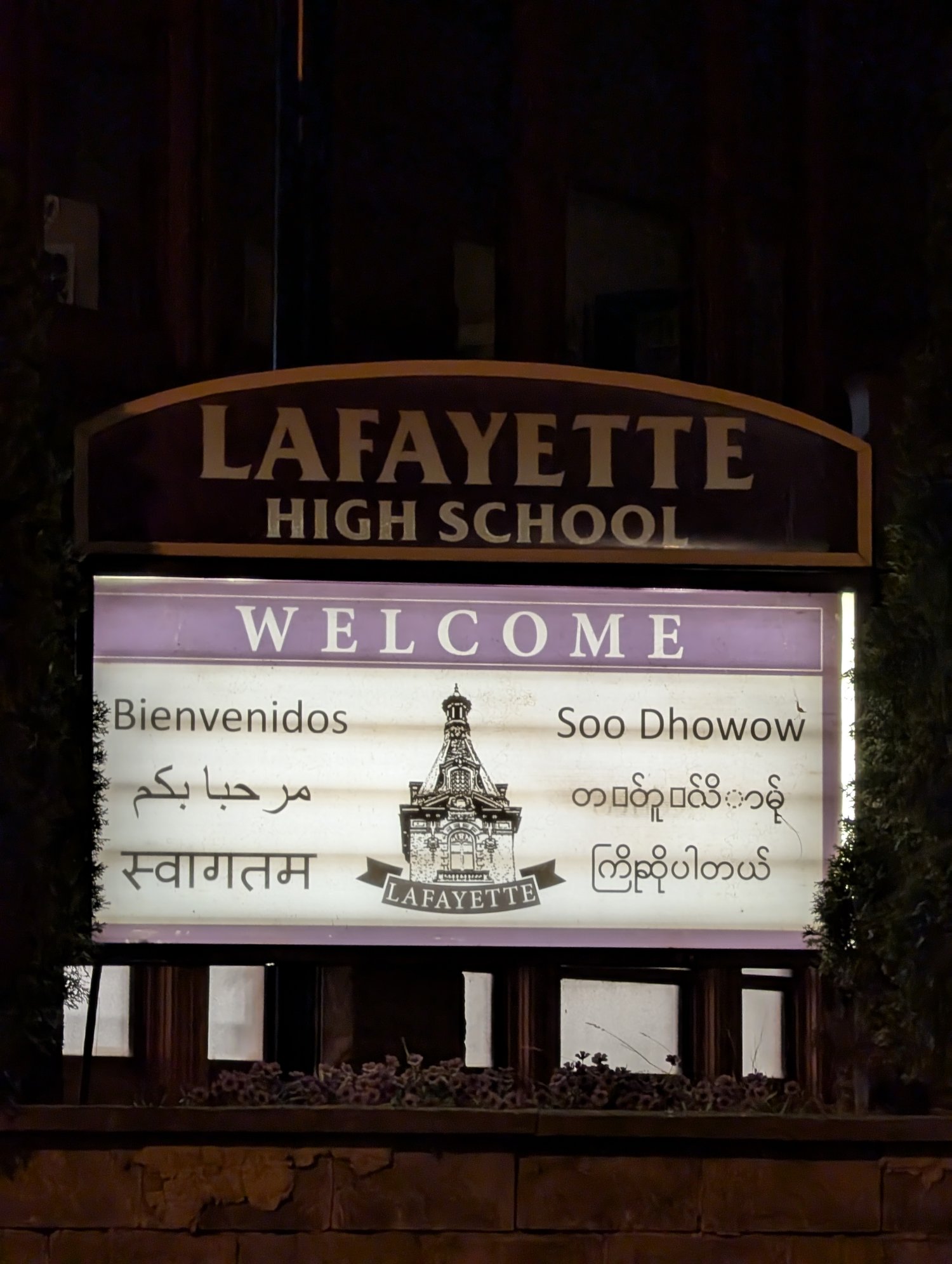
On Buffalo's West Side, the lighted sign outside the landmark Lafayette building still reads "Lafayette High School," and it says welcome in English, Spanish, Somali and Arabic, and in Devanagari and Burmese script. The school inside has a new name that reflects those languages. Lafayette High School is no more, and in its place is Lafayette International School, where nearly every student is learning English: in 2025-26, the most recent year in the state's published enrollment data, 465 of its 509 students, or 91.4%, were English learners.
The rest of the city has been moving in the same direction, more slowly. Across the Buffalo City School District↗ET, English learners were 20.0% of students in 2025-26, up from 10.8% in 2011-12 and nearly twice the statewide share of 10.7%. The district counted 5,988 English learners, its most in the 15 years of state enrollment files that report the group.
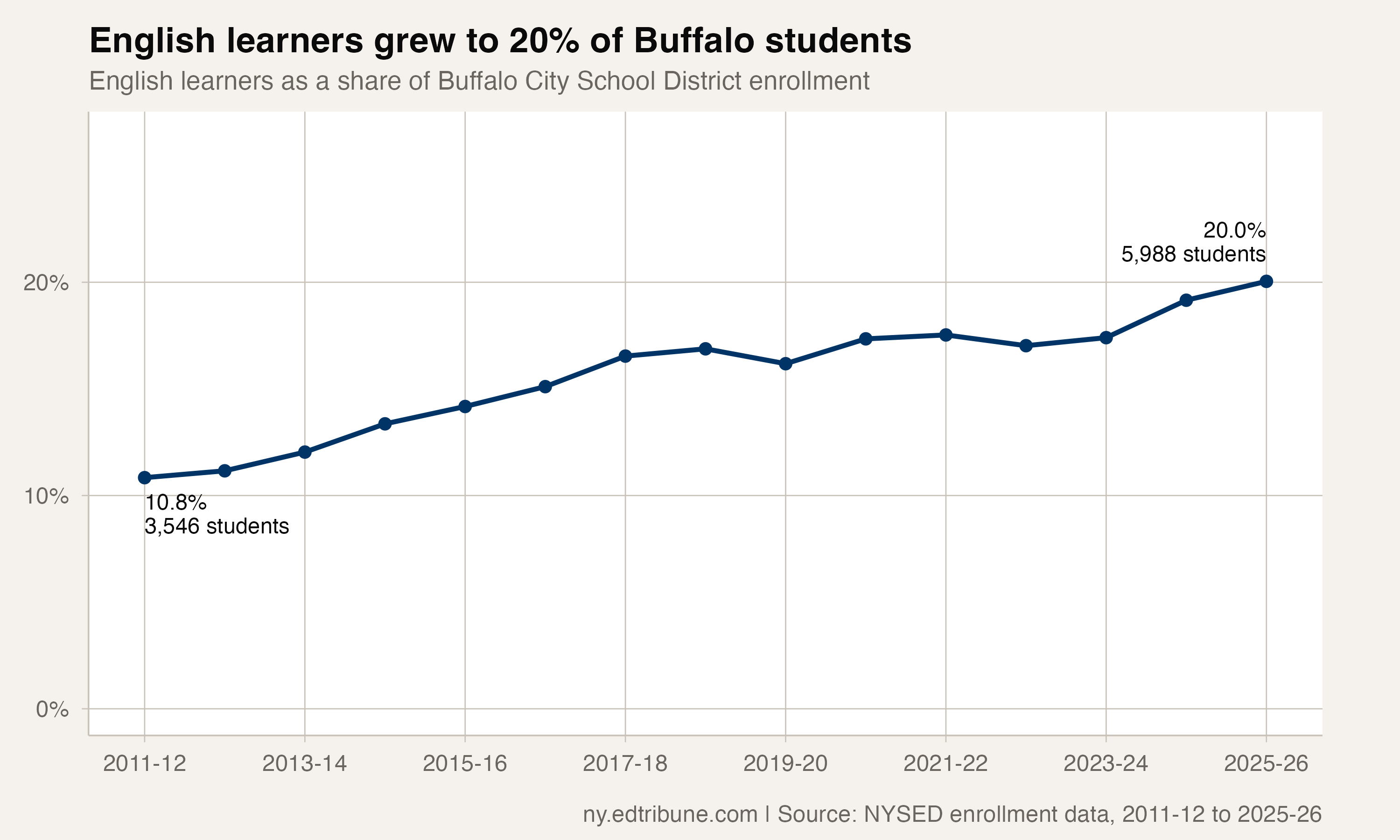
Over the same years the district got smaller. Total enrollment fell from 32,717 in 2011-12 to 29,876 in 2025-26. Buffalo had 2,442 more English learners at the end of that span and 5,283 fewer students who were not English learners. Of New York's four largest districts outside New York City, Buffalo had the highest English learner share in 2025-26 and the largest increase since 2011-12. Syracuse↗ET was at 18.4%, Rochester↗ET at 18.1% and Yonkers↗ET at 13.3%.
A city of new arrivals
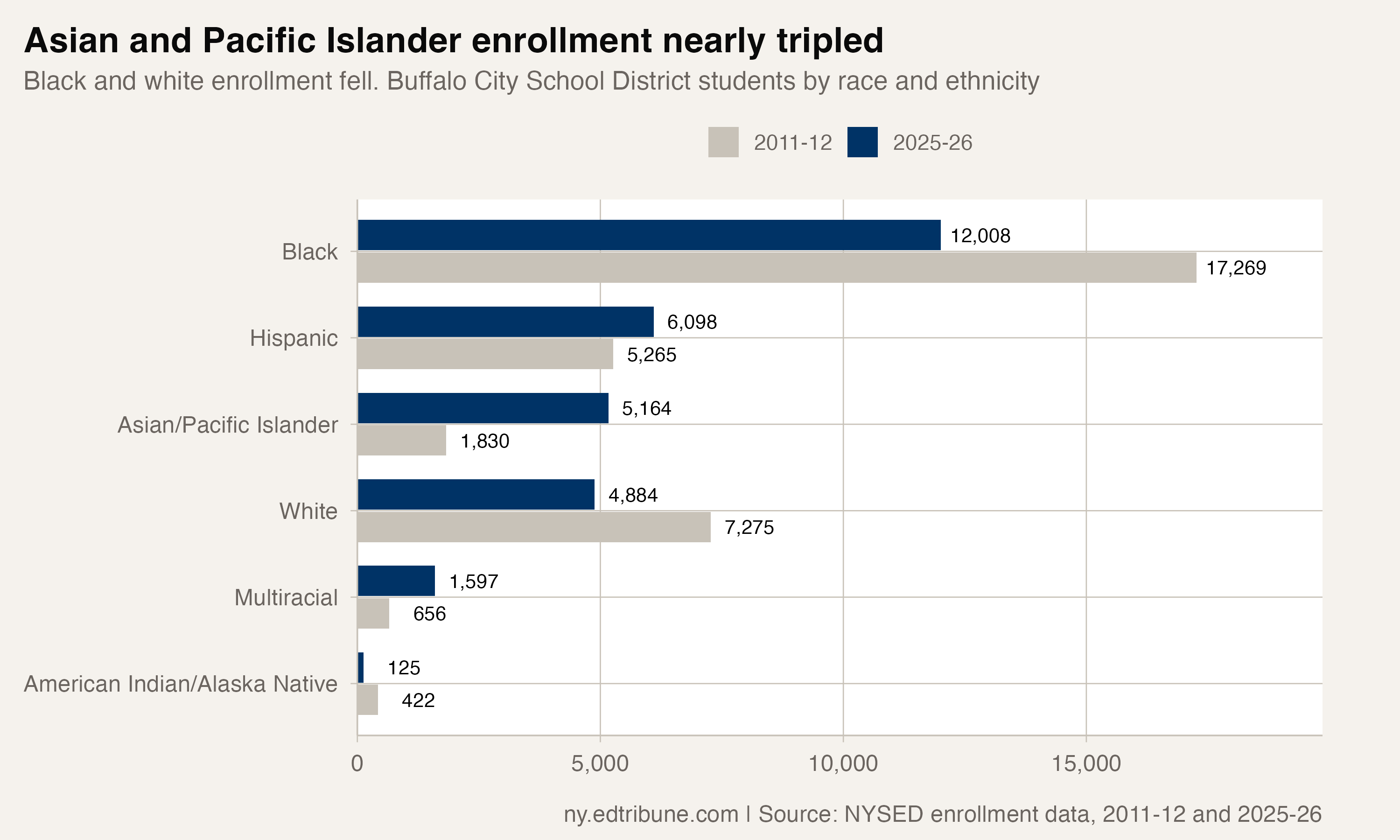
The district's racial makeup changed too. Its Asian and Pacific Islander enrollment rose in each of the 14 years after 2011-12, from 1,830 students to 5,164, or from 5.6% of the district to 17.3%. Black enrollment fell from 17,269 to 12,008 and white enrollment from 7,275 to 4,884. Those racial categories overlap with English learner status, which is a service designation rather than a nationality, and the state's files do not record where students were born or what languages their families speak.
Buffalo has long been a destination for resettled refugees. A 2020 account in the International Sociological Association's magazine Global Dialogue listed Burma, Somalia, Bhutan, Iraq and the Democratic Republic of Congo as the top countries of origin, and in 2021 WBFO reported that the district was preparing for newly arrived Afghan students. The enrollment counts do not separate students who arrived recently from children born in Buffalo who start school still learning English, so they give no way to tell how much of the growth each group accounts for.
The designated school
Lafayette was living with that change long before the rest of the city. In 2011-12, 57.7% of Lafayette High School's 737 students were English learners, more than five times the district's share. WBFO called it "the designated school for immigrants" in 2014 and reported that students new to English, some with no schooling before Lafayette, still had to take Regents exams.
The state pressed for change. In 2013, WBFO reported that State Education Commissioner John King was "calling for drastic change at East and Lafayette high schools", and by 2015 the State Education Department had designated Lafayette "out-of-time". Lafayette High's four-year graduation rate was 16.0% for the class of 2014, 18 graduates in a cohort of 116. In 2016, the school board approved the outlines of a plan under which Lafayette would be phased out and replaced.
The enrollment files show the handoff. Lafayette High enrolled 172 ninth graders in 2014-15 and one in 2015-16. Lafayette International opened in 2016-17 with 107 ninth graders, 99.1% of them English learners, as one of three school programs in the building. The third, the Newcomer Academy at Lafayette, appears in the state's files from 2016-17 through 2019-20. Lafayette High's final class, in 2018, graduated at 55.0%. After a 2020 school board vote to close the Newcomer Academy, its students were "absorbed into Lafayette starting next fall," WBFO reported, and Lafayette International grew from 351 students in 2019-20 to 489 in 2020-21.
Lafayette International's first classes graduated at far higher rates than Lafayette High's last ones: 83% of its first four-year class, in 2020, and 85% of the class of 2022. Those classes finished while the state exempted students from Regents exams it had cancelled during the pandemic, starting with the June 2020 exams, and the graduation files do not record which graduates used an exemption. The school's rate has fallen each year since, to 45% for the class of 2025 and 33% for that class's English learners. Many of those students had not left. Of the 118 who entered ninth grade in 2021-22, 40 were still enrolled in June 2025, and their five-year outcome is due in the state's next graduation release.
English learners across the city
In 2011-12, Lafayette High's English learners were 12.0% of all the English learners in Buffalo's district schools. In 2025-26, Lafayette International's 465 were 7.8%. The city had more English learners, and a larger share of them were in other buildings.
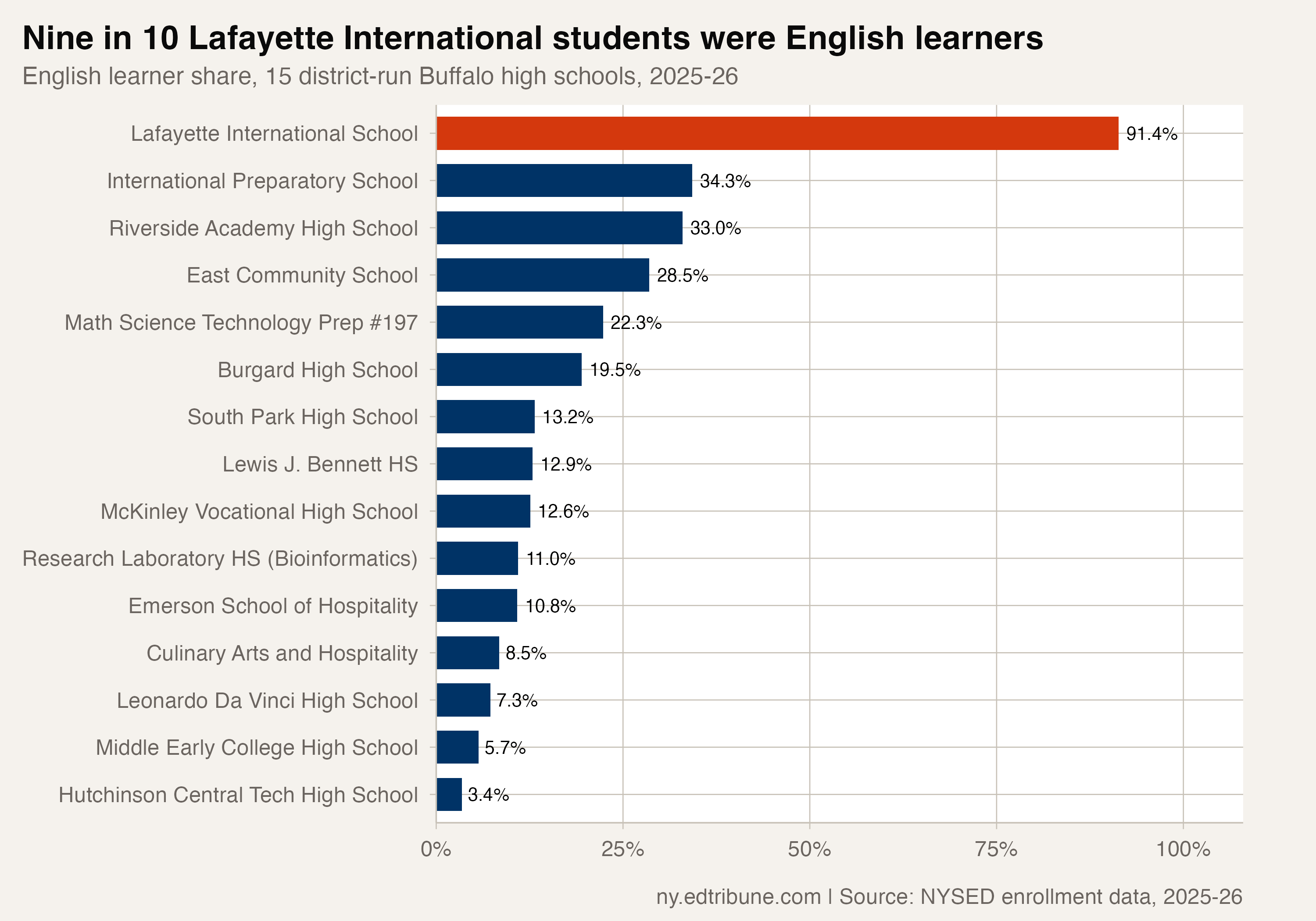
Of the 57 district schools that published an English learner count for 2025-26, 20 were at or above the district's 20.0% share. At four besides Lafayette International, English learners were close to half of all students or more: Herman Badillo Bilingual Academy (60.0%), the Bilingual Center (54.5%), Frank A. Sedita School #30 (52.2%) and International School (48.8%). International School enrolled 450 English learners, almost as many as Lafayette International.
Lafayette was once where Buffalo sent students who were new to English. By 2025-26 the district's own numbers described a different system, one where English learners were a fifth of all students and at least a fifth of the students in a third of the schools that reported a count.
Enrollment, English learner and graduation figures come from the New York State Education Department's public data site.
Detailed code that reproduces the analysis and figures in this article is available exclusively to EdTribune subscribers.
Discussion
Sign in to join the discussion.
Loading comments...